
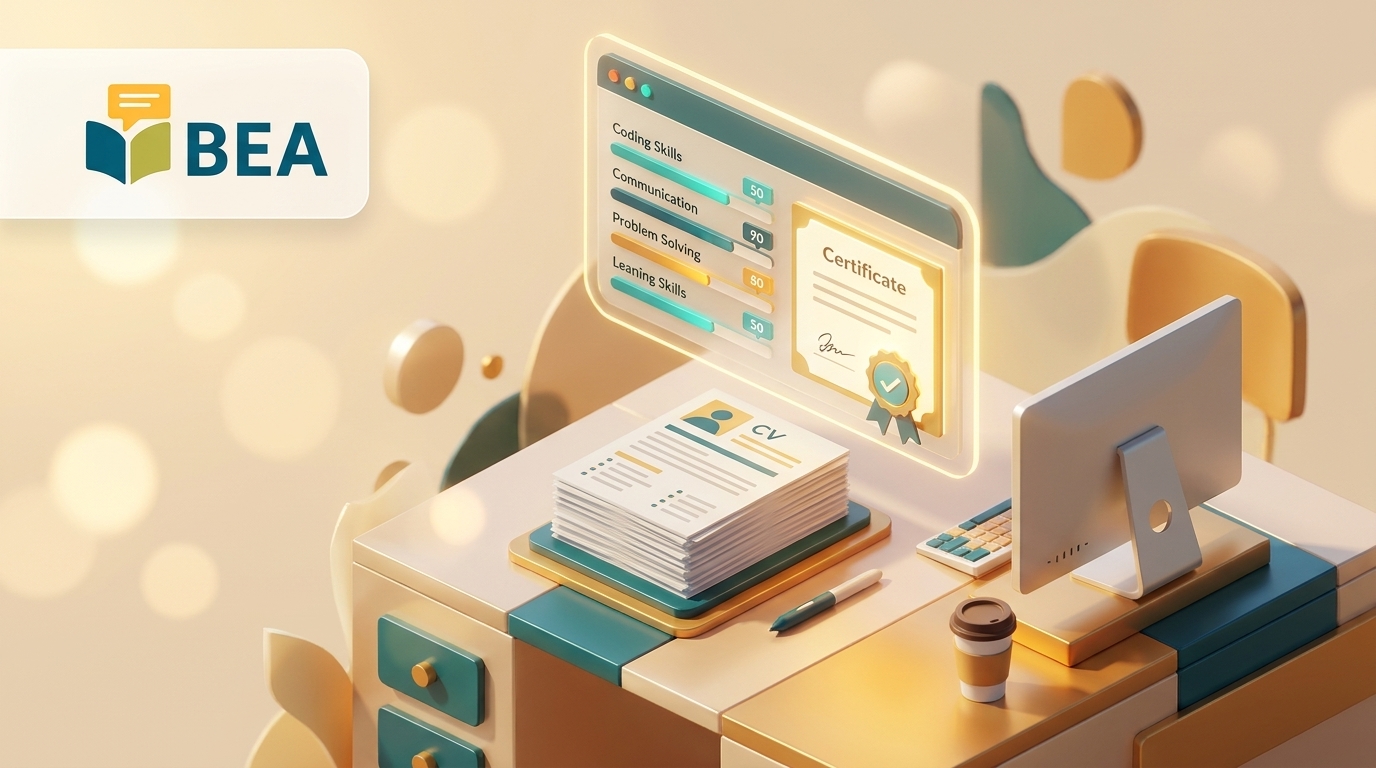
English proficiency is no longer a secondary consideration in modern recruitment. As employers compete for skilled talent across borders, English assessment hiring outcomes have become central to how recruiters filter, compare, and ultimately select candidates. Understanding this process helps you present your credentials with confidence — and helps HR teams build fairer, faster pipelines.
In 2026, recruiters routinely receive applications from candidates with varied linguistic backgrounds. A verified assessment score cuts through ambiguity. It gives decision-makers a consistent, objective data point before a single interview takes place.
What Role Does English Proficiency Data Play in Recruiter Decision-Making Before the Interview?
Recruiters make rapid judgements at the pre-screening stage. A CV signals experience; a covering letter signals communication style. However, neither document reliably confirms language ability under professional conditions.
This is where English assessment hiring outcomes begin to shape decisions. When a candidate submits a verified score report alongside their application, recruiters gain immediate confidence. They can assess whether a candidate meets the minimum language threshold for a role before investing time in interview scheduling.
For example, a logistics company hiring warehouse supervisors across three sites may set a minimum score threshold as part of its standard screening criteria. Candidates who meet it move forward automatically. Those who do not receive prompt, respectful feedback. The result is a faster, more equitable process for everyone involved.
According to the British Council’s 2026 English at Work report, employers consistently cite communication ability as a top hiring criterion — yet many admit they lack a systematic way to verify it. Proficiency data fills that gap precisely.
How English Assessment Hiring Outcomes Shape HR Scoring and Candidate Comparison
In practice, most HR teams use a weighted scorecard to compare candidates. Each data source — CV, reference, interview, and assessment — contributes to an overall profile. Assessment scores typically sit alongside, not above, other evidence.
That said, proficiency scores carry particular weight for roles requiring written reporting, client communication, or regulatory compliance. In those contexts, HR teams often treat a minimum score as a pass/fail gate before interview feedback enters the calculation.
Furthermore, assessment data integrates cleanly into Applicant Tracking Systems (ATS). An ATS is software that manages candidate applications digitally. A standardised score field means recruiters can filter or rank candidates at scale without manual review of every document.
Consequently, HR teams save significant time. One recruitment manager working in the healthcare sector noted that adding a verified English score requirement reduced their pre-screening workload by approximately 30%, because borderline applications self-selected out of the process. Tracking English assessment hiring outcomes at this stage also gives HR leadership meaningful data for refining future role specifications.
Which Hiring Stages Typically Use Assessment Evidence — Shortlisting, Offer, or Onboarding?
Assessment evidence appears across multiple hiring stages, though its function shifts at each one. At the shortlisting stage, scores act as threshold markers. At the offer stage, they provide documented justification for a hiring decision — particularly important in regulated industries.
In addition, some employers revisit assessment evidence during onboarding. They use scores to identify whether a new joiner would benefit from language support, internal training, or mentoring. This turns assessment data into a development tool, not just a selection filter.
Beyond this, legal and compliance teams increasingly ask HR to retain assessment records as part of their equal opportunities documentation. A verified, time-stamped score report creates an auditable evidence trail that protects both employer and candidate.
What Do Recruiters Do When Candidates Submit Different Accepted Tests Instead of a Single Provider’s Result?
Many employers accept several recognised English assessments. However, comparing scores across different tests creates a real practical challenge. Each provider uses a different scale, methodology, and scoring logic.
As a result, recruiters often convert scores to a common reference framework — most commonly the CEFR (Common European Framework of Reference for Languages). The CEFR uses levels from A1 (beginner) to C2 (mastery), giving recruiters a shared language for comparison.
Despite this, conversion is imperfect. A score on one test does not map precisely onto a score from another. Recruiters who receive mixed evidence sometimes request that all shortlisted candidates use a single specified provider, so comparisons remain consistent throughout the process.
How Does Verified Score Data Reduce Bias and Improve Consistency Across a Hiring Panel?
Hiring panels are human, and human judgement carries unconscious bias. A candidate’s accent, name, or nationality can subtly influence how panel members perceive their language ability. Verified assessment data counters this by providing an objective, panel-neutral benchmark.
More importantly, when every panel member sees the same verified score, discussions anchor to evidence rather than impression. This improves consistency, particularly in large organisations where different hiring managers assess candidates independently. Standardising English assessment hiring outcomes across panels is one of the most effective ways to protect both fairness and legal defensibility.
BEA English Assessment produces tamper-evident, shareable score reports that give hiring panels a single, trusted reference point. The result is fairer deliberation and more defensible decisions.
Getting Started: How to Submit Your Assessment Evidence
If your employer or recruitment agency has requested proof of English proficiency, the process is straightforward. Take the BEA English Assessment online, receive your verified score report, and share it directly with your recruiter.
BEA English Assessment is designed for professional candidates. The assessment is accessible, clearly structured, and produces a report that meets employer requirements across a wide range of sectors in 2026.
Before applying, check whether your employer specifies a minimum level. If they do, aim to complete your assessment with enough time to retake it if needed.
Conclusion
English assessment hiring outcomes influence every stage of the recruitment journey — from the first shortlist to onboarding documentation. Verified score data gives recruiters confidence, reduces panel bias, and creates an auditable record that protects all parties.
If you need to demonstrate your English proficiency, take the BEA English Assessment today, receive your verified report, and share it with any employer who requests evidence of your language ability.