
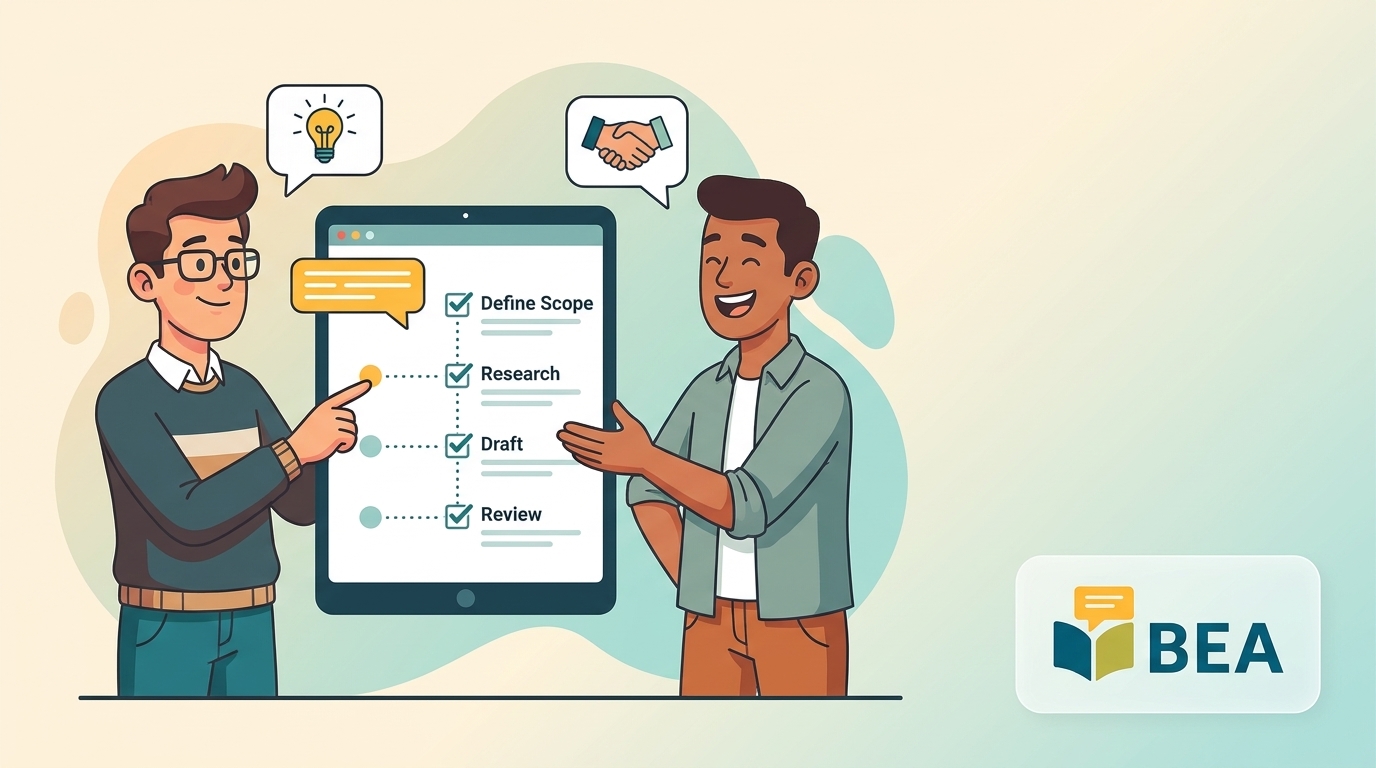
Starting a new role or applying through a recruitment agency often means completing an English assessment first. Yet many candidates arrive unsure of what to expect. This BEA test structure guide exists to change that. Understanding exactly what you will encounter — section by section — removes uncertainty. It allows you to focus on demonstrating your real language ability.
The BEA Assessment (Business English Assessment) measures workplace English across multiple skill areas. It is used by employers and recruiters across the UK and internationally. Its purpose is to verify that candidates can communicate effectively in professional environments. In 2026, demand for verified English credentials in hiring has never been higher.
Furthermore, preparation is not about memorising answers. It is about knowing the format, pacing yourself appropriately, and understanding what each task actually evaluates.
BEA Test Structure Guide: What Is the Assessment and How Is It Delivered?
The BEA Assessment is an online English proficiency test designed specifically for workplace and recruitment contexts. Unlike general academic English tests, BEA focuses on language skills that matter in a professional setting — writing emails, understanding workplace documents, and following verbal instructions.
In practice, you complete the assessment online through the official BEA English Assessment platform. No specialist software or downloads are required. You need a reliable internet connection, a quiet environment, and approximately 60 to 90 minutes of uninterrupted time.
Notably, the assessment is adaptive in approach. Tasks reflect realistic workplace scenarios rather than abstract grammar exercises. According to research published by the British Council, workplace communication is consistently ranked among the top skills employers seek. You can review that research at the British Council’s research pages.
For example, a candidate applying for an administrative role might encounter a task asking them to respond professionally to a client query. This mirrors exactly the kind of language use that matters on the job. That is what makes the BEA test structure guide so valuable — it connects format to purpose.
Breaking Down Each Section: What You Will See and What It Measures
This BEA test structure guide covers each core component so you arrive fully informed.
Reading Comprehension
The reading section presents workplace texts — such as company policies, internal memos, or client communications. You read the material and answer questions that test both understanding and inference. Tasks assess whether you can extract key information quickly and accurately.
Writing Tasks
In this section, you produce written responses to realistic scenarios. You might draft a short email, summarise information, or complete a structured written task. Assessors evaluate grammar, vocabulary range, coherence, and professional tone.
Listening Comprehension
However, the assessment does not stop at written skills. The listening component plays audio of workplace conversations, announcements, or instructions. You then answer questions about what you heard. This section measures your ability to process spoken English in professional contexts — a skill that matters from day one in any role.
Vocabulary and Language Use
Beyond this, the assessment includes tasks targeting precise vocabulary and grammatical accuracy. These are not trick questions. They reflect the standard of English required to function confidently in a UK or international business environment.
As a result, the overall BEA test structure gives employers a multidimensional picture of your English ability — not just a single score. Candidates who understand this structure perform more consistently across all sections.
You can learn more and access all candidate resources through BEA English Assessment at beaenglish.co.uk, the only official platform for registration and testing.
How to Read Your Results and What to Do Next
Once you complete the assessment, your results are processed and shared with the employer or recruitment agency that requested the test. In most cases, you also receive your own copy of the results report.
Therefore, understanding your report matters. Your results typically show a score or proficiency level across the assessed skill areas. This allows employers to compare candidates objectively and identify the right fit for specific roles.
Meanwhile, if your results indicate room for improvement — in writing or listening, for example — treat this as constructive guidance. Many candidates use their first BEA report to identify focused study priorities before their next application.
In addition, this BEA test structure knowledge helps you interpret which section scores correspond to which workplace skills. A strong writing score signals readiness for roles involving documentation, correspondence, or client-facing communication.
Get Started with the BEA Assessment Today
Your next step is straightforward. Review the sections outlined in this BEA test structure guide, practise in those specific skill areas, and then register to take the test.
Consequently, arriving prepared is the most effective thing you can do. Candidates who understand the format report feeling significantly more confident — and confidence directly supports performance.
Conclusion
This BEA test structure guide has walked you through every component of the assessment — from delivery format to individual task types to reading your results. With this knowledge, you are no longer walking in blind. You know what each section measures and why it matters to your prospective employer.
Ready to begin? Register and take the BEA Assessment directly at BEA English Assessment — beaenglish.co.uk — the only official platform for candidates and employers alike.