
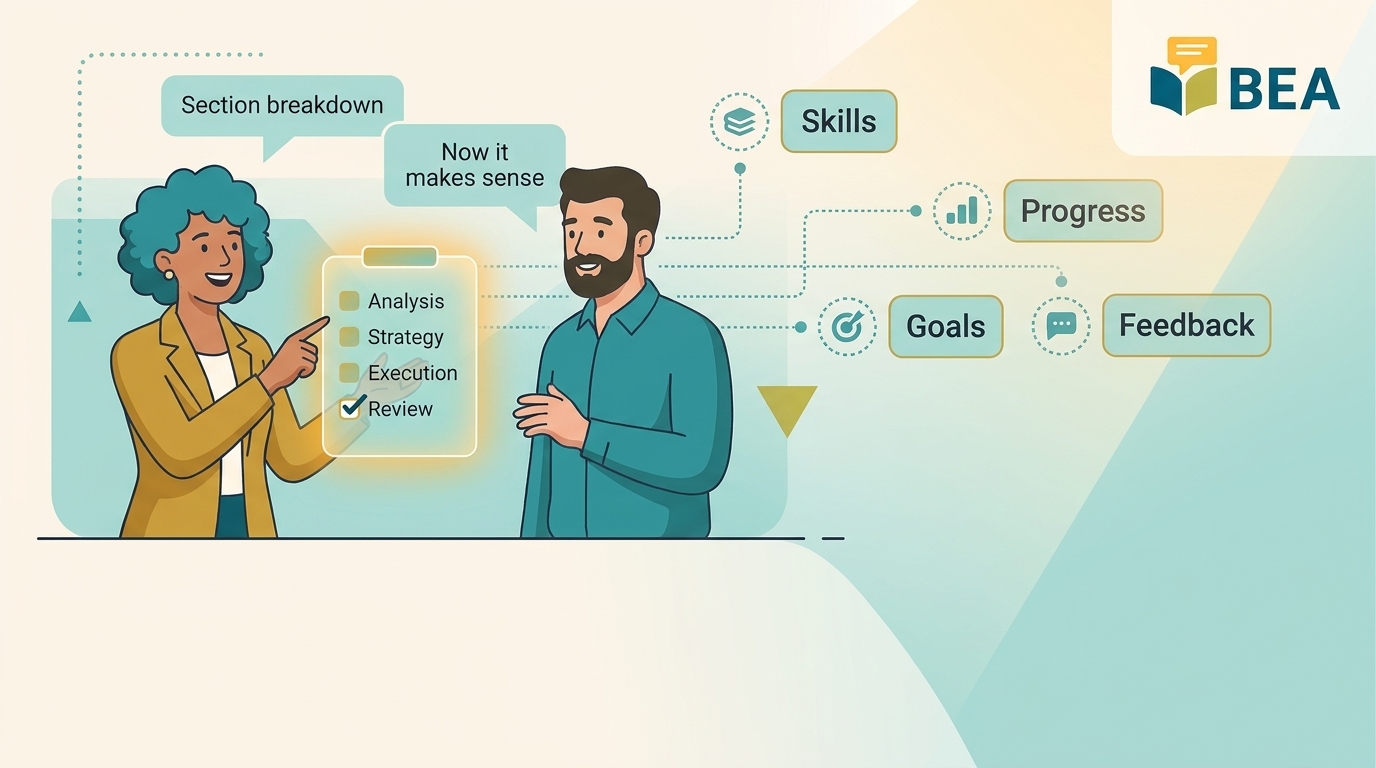
Facing a workplace English test for the first time can feel daunting, especially when you are unsure what to expect. This complete BEA assessment sections guide gives you a clear, honest breakdown of every part of the test. By understanding the structure before you sit down, you can approach each section calmly and perform at your true level.
Employers and recruitment agencies across the UK increasingly use standardised English assessments to benchmark candidates objectively. Knowing what examiners look for — and why — transforms a test from something threatening into something manageable. Read on to discover exactly how the BEA is built, what skills each part measures, and how to make the most of your test day.
BEA Assessment Sections Guide: An Overview of What the Test Covers
The BEA (Business English Assessment) measures the real-world English skills that employers need in professional settings. It does not test obscure grammar rules or academic vocabulary disconnected from daily work. Instead, every section reflects genuine workplace communication challenges.
The assessment covers four core skill areas: reading comprehension, writing ability, listening, and language use in context. Each section is timed independently, so a stronger performance in one area cannot compensate for a weak one elsewhere. This design gives both employers and candidates a granular, honest picture of proficiency.
Furthermore, the BEA aligns with the Common European Framework of Reference (CEFR), the internationally recognised standard for language ability. According to the Council of Europe, the CEFR is used by over 50 governments worldwide to benchmark language qualifications. This alignment means your BEA result carries genuine credibility with recruiters across sectors.
In practice, the full assessment typically takes between 60 and 90 minutes to complete. Sections are delivered digitally, allowing candidates to complete the test remotely or at a designated test centre. The format is consistent, so this BEA assessment sections guide applies whether you are sitting in an office or at home.
Breaking Down Each Section: Skills Tested, Format, and What Examiners Look For
Reading Comprehension
This section presents several professional texts — emails, reports, or memos — followed by multiple-choice and short-answer questions. Examiners test your ability to locate specific information quickly and infer meaning from context. In 2026, most workplace roles require rapid, accurate reading, making this section especially relevant.
However, speed alone is not enough. Examiners also reward careful comprehension — answers that reflect genuine understanding rather than keyword matching.
Writing Ability
Candidates produce one or more short written responses, such as a professional email or a brief summary. Examiners assess clarity, structure, appropriate tone, and grammatical accuracy. For example, a candidate asked to draft a complaint email should demonstrate formality, logical sequencing, and concise phrasing — all skills employers value immediately on hiring.
In addition, spelling and punctuation matter here. Consistent errors signal to employers that written communication may need extra support in the workplace.
Listening
The listening section plays audio recordings of workplace scenarios — meetings, instructions, or telephone calls. You then answer comprehension questions. This section tests focused attention and the ability to extract key information under time pressure.
Notably, candidates often underestimate listening difficulty. Background noise in recordings or fast-paced speech can challenge even confident English users. Practising with professional audio content before your test day makes a measurable difference.
Language Use in Context
This section assesses grammar, vocabulary, and register (the appropriateness of language for a given situation). Questions present sentences or short passages with gaps or errors for you to correct or complete. The focus remains firmly on professional English rather than academic abstractions.
Using this BEA assessment sections guide alongside the tailored preparation resources available at BEA English Assessment will help you approach each part of the test with greater confidence.
Common Candidate Questions: Timing, Difficulty, and What to Expect on Test Day
How long does each section take? Timing varies by section, but each part has a clear countdown visible on screen. No section requires you to rush — the pacing suits a focused, careful approach rather than a race.
Is the test difficult? The BEA assessment sections are designed to reflect B1–C1 CEFR levels (intermediate to advanced). Most professional candidates find the content recognisable, though the timed format adds pressure. Preparation — not luck — is the strongest predictor of a good result.
What happens on the day? You receive clear instructions before each section begins. No specialist equipment is required beyond a stable internet connection and working headphones for the listening section.
That said, technical checks before you begin are essential. Test your audio, screen resolution, and browser compatibility at least 24 hours in advance. Reviewing this BEA assessment sections guide the evening before your test is a simple, effective final step.
Getting Started: Your Practical Preparation Plan
Begin by reviewing the four skill areas above and honestly rating your confidence in each. Identify your weakest area and dedicate extra practice time there in the weeks before your test. Reading professional documents, writing practice emails, and listening to business podcasts all count as useful preparation in 2026.
Beyond this, familiarity with the format itself reduces anxiety significantly. Understanding the BEA assessment sections before you sit them is half the battle. Use the resources available through BEA English Assessment to register, review guidance, and approach your test with a clear plan.
Conclusion: Walk Into Your Test With Clarity
This BEA assessment sections guide has decoded every part of the test — from reading and writing through to listening and language use. You now know what examiners look for, how each section is structured, and what practical steps to take before test day. That knowledge is a genuine competitive advantage.
Ready to understand exactly what awaits you? Visit BEA English Assessment at beaenglish.co.uk to register and take the BEA Assessment with confidence.