
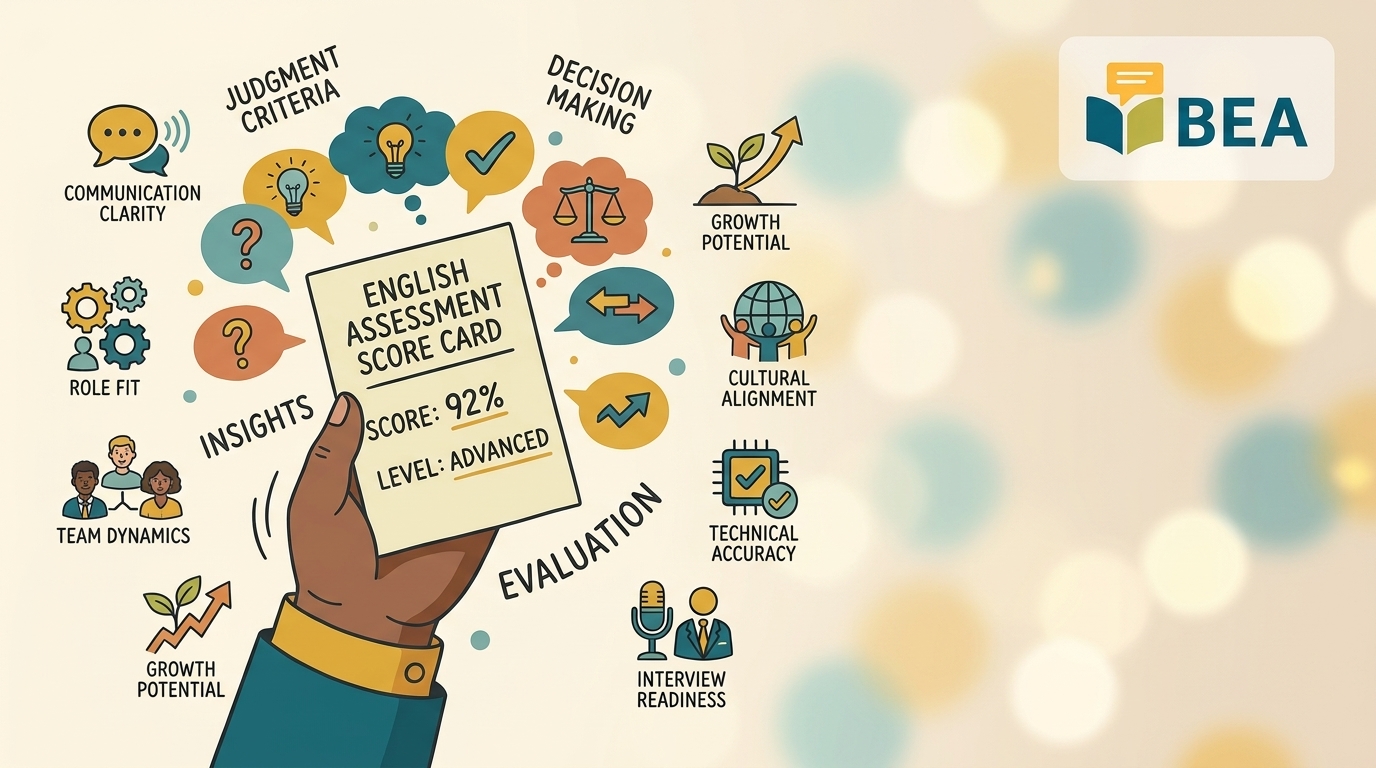
A verified English score arrives in an HR inbox. What happens next? Most candidates assume the number speaks for itself. In reality, English assessment hiring decisions involve a layered series of professional judgments — and understanding those judgments can change how you approach your assessment entirely. Knowing what recruiters actually do with your result puts you in a stronger position, whether you are a candidate preparing to test or a hiring manager reviewing scores from your shortlist.
HR professionals rarely treat a single score as a pass/fail switch. Instead, they apply context, compare evidence, and make deliberate calls against role requirements. This article walks through seven of those calls — and explains the logic behind each one.
How English Assessment Hiring Decisions Begin: Why a Proficiency Score Is a Starting Point, Not a Final Verdict
In practice, a proficiency score functions as structured evidence — not a verdict. HR teams use it to anchor a conversation, not end one.
Consider the difference between a customer-facing support role and a back-office data entry position. Both may require English. However, the communication demands differ significantly. A score that clears the threshold for one role may fall short for the other — even if the number looks identical on paper.
Furthermore, organisations increasingly recognise that language proficiency exists on a spectrum. The Common European Framework of Reference (CEFR), used globally to benchmark language ability, describes six levels from A1 to C2. Most professional roles in the UK target B2 or above. That said, some technical roles with limited client contact may accept B1 candidates if other competencies are strong.
As a result, HR teams treat the score as the starting point for a structured conversation — not the final word.
The 7 Judgment Calls: From Minimum Thresholds to Role-Specific Benchmarks
English assessment hiring decisions rarely follow a single script. Here are the seven calls HR professionals most commonly make.
1. Setting a minimum threshold. HR defines the lowest acceptable score before shortlisting begins. This removes subjectivity from the first filter.
2. Adjusting for role seniority. A junior administrator and a senior account manager face different language demands. Benchmarks shift accordingly.
3. Comparing against team norms. Some teams benchmark against their current highest performers. A new hire scoring below that norm raises a flag.
4. Checking skill balance. Overall scores can mask weaknesses. An HR team may check whether reading, writing, or listening scores reveal a specific gap.
5. Weighting for client-facing duties. Roles involving direct client communication attract stricter language standards than internal-only positions.
6. Factoring in the candidate’s first language. A native Arabic speaker achieving B2 English may demonstrate greater linguistic agility than a native French speaker at the same level — context matters.
7. Revisiting scores after interview. If interview performance contradicts the assessment score, HR investigates rather than simply accepting either data point.
How Recruiters Weigh Assessment Results Alongside Interview and CV Evidence
No responsible recruiter relies on a single data source. In practice, the English assessment result sits alongside CV evidence, interview performance, and sometimes a written task or role-play exercise.
For example, a candidate who scores well on the written component but struggles with spoken fluency in interview may need additional support in client calls. By contrast, a candidate with a slightly lower overall score who demonstrates confident verbal communication may outperform expectations in practice.
Moreover, the verifiability of the score matters. A result from BEA English Assessment carries credibility because it is independently verified and shareable — recruiters know it reflects genuine, uncoached performance. Unverified self-reported language skills, by comparison, carry far less weight in a structured hiring process. This is precisely why English assessment hiring decisions made with verified data tend to be more consistent and legally defensible than those based on impression alone.
Consequently, candidates who combine a verified score with strong supporting evidence across multiple assessment points tend to advance furthest in competitive shortlists.
What Happens When Two Candidates Score Identically — And How HR Breaks the Tie
Identical scores occur more often than candidates expect. When they do, HR teams apply a secondary layer of judgment.
First, they examine the skill-level breakdown. Two candidates may share an overall B2 classification. However, one may show stronger writing while the other excels in listening comprehension. Role requirements then determine which skill matters more.
In addition, HR teams consider consistency across assessment attempts. A candidate who scores steadily across multiple touchpoints signals reliability. A candidate with a strong score but inconsistent interview language raises questions about assessment conditions.
Beyond this, soft factors come into play — response quality during interview, clarity of written communication in the application itself, and references that speak to professional language use. The score breaks the first tie; these secondary signals break the second.
Common Mistakes HR Teams Make When Interpreting English Assessment Data
Despite good intentions, HR teams sometimes misread assessment results. Awareness of these errors helps both recruiters and candidates advocate more effectively.
Over-relying on a single cut-off score. Setting a rigid threshold without reviewing the skills breakdown ignores nuance that the data clearly provides.
Ignoring role context. A score appropriate for a logistics coordinator role may be entirely insufficient for a client-facing legal assistant. Applying one benchmark across all roles introduces risk.
Failing to update benchmarks. Many organisations set thresholds in 2024 and have not reviewed them since. In 2026, role requirements and candidate pools have shifted — benchmarks should reflect current demands.
Discounting verified assessments. Some HR teams weight an in-house interview impression above a verified external score. In fact, verified scores reduce unconscious bias and provide legally defensible evidence. Sound English assessment hiring decisions depend on treating verified data as the primary source of truth, not a secondary one.
Not sharing feedback with candidates. Candidates who understand their score and its implications can address gaps and return with stronger results. Transparency benefits both sides.
How to Prepare Before Your Score Reaches an HR Inbox
With this in mind, candidates can take deliberate steps before submitting an assessment. Understanding the role’s language demands — client-facing versus internal, written versus spoken — helps you focus your preparation on the skills that matter most to that specific employer.
Additionally, using a verified assessment platform gives you a credible, shareable result. The BEA English Assessment generates a detailed score report that breaks down your performance by skill area. This means you can share targeted evidence with recruiters, not just a single headline number.
Therefore, approach your English assessment not as a hurdle to clear, but as an opportunity to present structured, verifiable evidence of your communication ability.
Conclusion: What Your Score Really Communicates
English assessment hiring decisions are never made in isolation. Your score communicates ability, consistency, and professionalism — but recruiters apply judgment at every stage of the process. Understanding that judgment puts you ahead.
Visit BEA English Assessment to take the assessment, receive a verified score report, and demonstrate exactly what your English skills can deliver to any employer or recruiter who asks.