
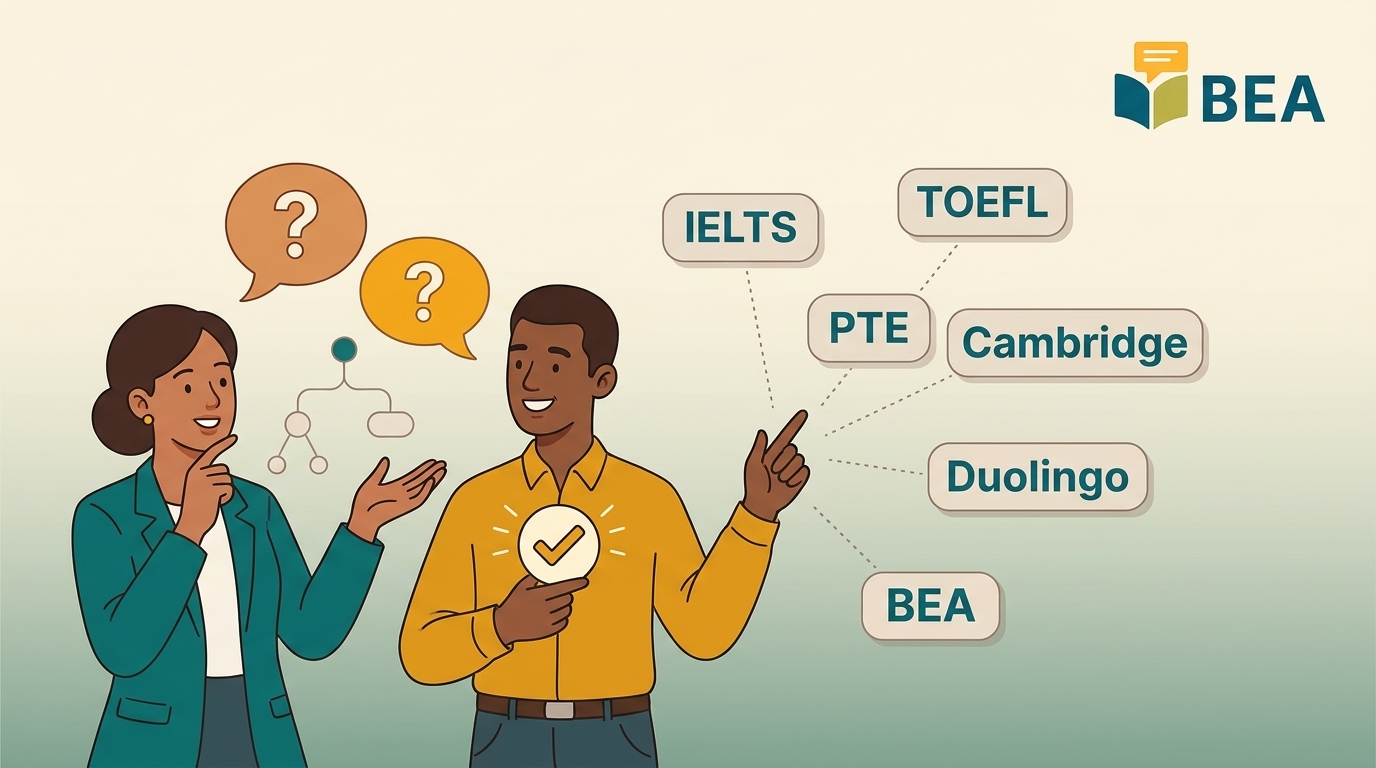
Choosing the right English test can feel overwhelming. Whether you are a candidate preparing to join a UK employer or a recruiter commissioning assessments for new hires, the differences between BEA vs IELTS TOEFL and other leading tests matter enormously. The wrong choice wastes time, money, and opportunity.
In 2026, the English language testing market includes at least six widely recognised assessments. Each one serves a different purpose. Understanding those differences — clearly and quickly — helps you make the right decision the first time.
BEA vs IELTS TOEFL and Other Tests: A 60-Second Decision Table
| Test | Primary Purpose | Typical Completion Time | Results Speed | Cost Range | |—|—|—|—|—| | BEA | Workplace English (employer-commissioned) | Under 60 minutes | Same day | Low | | IELTS | Academic & immigration | 2 hrs 45 mins | 3–5 days | £~220 | | TOEFL iBT | Academic admissions (US focus) | ~3 hours | 4–8 days | ~$235 | | PTE Academic | Academic & visa applications | ~2 hours | 1–5 days | £~175 | | Cambridge English | Recognised proficiency certificates | 2–4 hours | Several weeks | £~175+ | | Duolingo English Test | Remote academic admissions | ~1 hour | 2 days | ~$65 |
The table above makes one thing clear. Most established tests target academic admissions or visa applications. BEA — the Business English Assessment — stands apart as a workplace-focused tool, commissioned directly by employers and recruiters to verify on-the-job language capability.
Furthermore, BEA does not require a test centre visit. Candidates complete it online, making it uniquely practical for busy professionals and fast-moving recruitment pipelines.
What Each Test Is Actually Designed For — and Why That Changes Your Decision
Understanding design intent is critical. IELTS (International English Language System) and TOEFL (Test of English as a Foreign Language) were built for universities and immigration authorities. They measure broad academic English across four skills: reading, writing, listening, and speaking.
By contrast, PTE Academic and Cambridge English qualifications — such as the B2 First or C1 Advanced — also serve academic and professional recognition purposes, but they issue certificates that carry long-term reputational weight. These are credentials candidates accumulate and display throughout their careers.
Duolingo English Test arrived as a lower-cost, faster alternative for academic admissions. However, its employer acceptance rate in the UK remains limited compared to established tests.
In fact, a 2026 IELTS report confirms that over 11,500 organisations worldwide recognise IELTS results — the vast majority being educational institutions and government bodies. That reach is impressive, but it reflects academic and immigration demand, not workplace hiring workflows.
Notably, when weighing BEA vs IELTS TOEFL for recruitment purposes, the distinction becomes even sharper. BEA was designed specifically for employment contexts. BEA English Assessment delivers results that give recruiters and employers a clear, fast snapshot of a candidate’s practical communication ability — the skills that matter on the job.
Scenario-by-Scenario Guide: Which English Test Should You Take?
Knowing your specific situation simplifies the decision considerably. Consider these common scenarios.
You Are Applying to a UK University
IELTS or PTE Academic is almost always required. Most UK universities specify minimum scores — typically IELTS 6.0 to 7.0 depending on the programme. TOEFL scores are also widely accepted.
You Need a Visa or Immigration Document
IELTS (specifically IELTS for UKVI) or a Home Office-approved Secure English Language Test (SELT) applies. Neither BEA nor Duolingo qualifies for UK visa purposes.
Your Employer or Recruiter Has Asked You to Take a Test
This is where BEA is the right fit. In practice, BEA vs IELTS TOEFL is not a close comparison for workplace screening — BEA wins on speed, cost, and relevance. When a business needs to verify your workplace English before hiring or onboarding, BEA provides fast, affordable, employer-trusted results. Candidates complete it online and receive results the same day.
You Want a Prestigious Long-Term Certificate
Cambridge English qualifications — B2 First, C1 Advanced, or C2 Proficiency — carry lasting prestige. They are ideal if you want a credential to add to your professional profile over time.
Your Recruiter Needs to Screen Multiple Candidates Quickly
In addition to speed, cost efficiency matters at scale. BEA allows recruiters and HR teams to commission assessments directly. Consequently, it is the most practical solution for volume hiring in 2026. For example, a recruiter screening twenty candidates can commission BEA assessments and receive all results the same day — something neither IELTS nor TOEFL can offer.
Frequently Asked Questions About Choosing Between These Six Assessments
Is BEA accepted instead of IELTS or TOEFL for visa applications? No. UK visa applications require government-approved tests such as IELTS for UKVI. BEA serves employment screening, not immigration.
Can I use my IELTS score for a job application? Yes, many employers accept IELTS results. However, IELTS tests academic English — not the specific workplace communication skills BEA measures. Your employer may still prefer BEA for its speed and relevance.
How quickly do BEA results arrive? Results arrive the same day. Therefore, BEA is significantly faster than IELTS, TOEFL, and Cambridge English in recruitment contexts.
Does BEA test all four skills — reading, writing, listening, and speaking? BEA focuses on the language skills most relevant to professional workplace settings. Check BEA English Assessment directly for the current assessment format and skill coverage.
Is Duolingo English Test accepted by UK employers? Acceptance varies by employer. Duolingo is primarily built for academic admissions, and its recognition among UK businesses in 2026 remains lower than established alternatives.
What does BEA cost compared to IELTS or TOEFL? BEA is considerably more affordable than IELTS (~£220) or TOEFL (~$235). As a result, it is the cost-effective choice for employer-commissioned assessments. Meanwhile, academic candidates who need recognised scores for universities will still find IELTS and TOEFL the appropriate option.
Conclusion
When comparing BEA vs IELTS TOEFL and the full landscape of English assessments, one truth stands out: the best test is the one designed for your actual goal. Academic applicants need IELTS, TOEFL, or PTE. Immigration candidates require approved SELTs. However, when an employer or recruiter needs fast, workplace-relevant English verification in 2026, BEA is the clear answer.
Ready to take BEA? Visit BEA English Assessment to purchase and complete your assessment — results delivered fast, accepted by UK employers alongside IELTS, TOEFL, PTE Academic, Cambridge English, and Duolingo.