
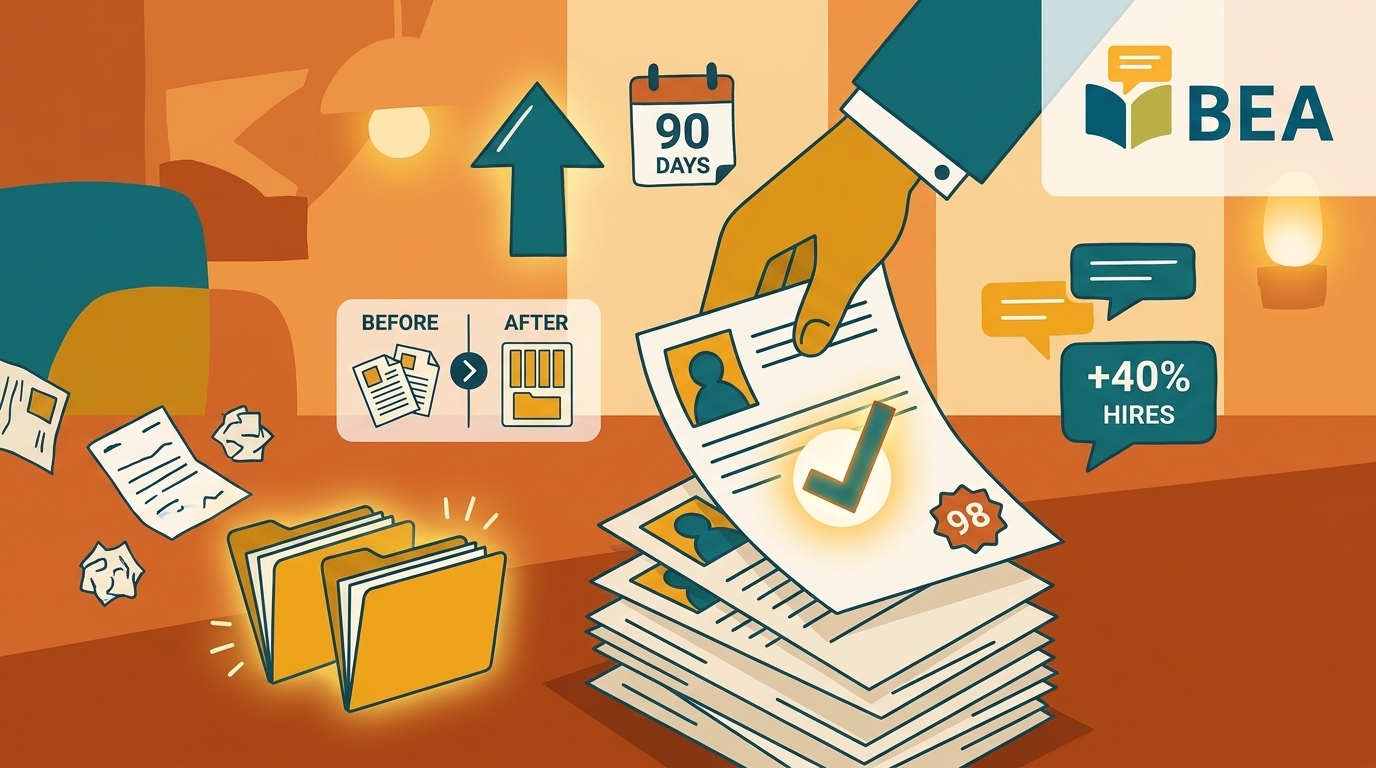
What happens when a recruiting team stops relying solely on CVs? This BEA hiring outcomes case study answers that question directly. In 2026, one mid-sized UK recruitment agency decided to pilot English proficiency scoring alongside traditional CV reviews. Within 90 days, their hiring process looked — and performed — very differently. This article walks through what changed, why it worked, and what any hiring team or candidate can learn from the experience.
The challenge they faced was familiar. Candidates with polished CVs were advancing to interview stages only to struggle with written communications and client-facing tasks. Something had to change.
The Problem: What Was Going Wrong Before English Proficiency Scores Entered the Picture
Before the pilot began, the agency’s shortlisting process relied entirely on CV content and a brief phone screen. Recruiters made subjective judgements about language ability based on how a CV was written. However, CVs are often edited by third parties. That means they rarely reflect a candidate’s true writing level.
For example, one recurring issue involved candidates hired into client-facing roles who could not produce clear written reports. The agency estimated that roughly 30% of their placements in communication-heavy roles required unexpected post-hire coaching in early 2026. This created delays, cost the agency client goodwill, and inflated onboarding budgets.
In addition, the recruiters themselves felt unsure how to fairly assess language skills without a standardised benchmark. Gut instinct is not defensible in a compliance-conscious hiring environment. The team needed an objective, CEFR-aligned measure. CEFR stands for the Common European Framework of Reference — the internationally recognised scale for language ability, running from A1 (beginner) to C2 (mastery).
Consequently, the agency began exploring structured English assessments. They wanted something that could accompany CV submissions without adding significant friction for candidates.
The Shift: How Accepting BEA (and Equivalent CEFR Tests) Changed the Shortlisting Process
The change the agency made was deliberate and staged. From May 2026, all candidates applying for roles requiring strong written English were invited to complete a BEA English Assessment before shortlisting began. The BEA produces a verified CEFR-level score that recruiters can read alongside a CV.
In practice, shortlisters now used a simple two-column review: CEFR score on the left, CV experience on the right. A candidate with a B2 score — upper-intermediate, typically sufficient for professional correspondence — moved forward if their experience also matched. A candidate with an impressive CV but an A2 score triggered a conversation about role fit. That was not an automatic rejection.
Notably, the process respected candidates’ dignity. Scores were treated as data points, not pass-or-fail gates. BEA English Assessment provides score reports that include sub-skill breakdowns — reading, writing, listening, and speaking. This gives recruiters nuanced information rather than a single number.
Furthermore, the team trained shortlisters over two half-day sessions on how to interpret CEFR levels in the context of specific job families. This internal upskilling proved as valuable as the scores themselves. More importantly, this BEA hiring outcomes case study confirms that score interpretation training must accompany any assessment rollout. The tool alone is not sufficient without recruiter readiness.
The Results: Measurable Hiring Outcomes After 90 Days of Score-Informed Decisions
By August 2026 — exactly 90 days into the pilot — the agency reviewed placement data. The results were clear. Post-hire coaching requirements dropped from 30% of placements to 11% in communication-heavy roles. That single metric justified the entire pilot.
Beyond this, time-to-offer shortened by an average of four days. Recruiters spent less time arranging supplementary telephone assessments because the BEA score already answered the language-ability question. Candidates, in turn, received faster decisions. That improvement lifted the agency’s candidate satisfaction ratings noticeably.
As a result, the agency extended the pilot to all professional and administrative role categories for the remainder of 2026. Client feedback also improved. According to a 2025 CIPD Labour Market Outlook report, 44% of UK employers identify communication skills as a key gap in new hires. This BEA hiring outcomes case study demonstrates one replicable method for closing that gap. You can read the full findings here: CIPD Labour Market Outlook.
Therefore, the evidence strongly supports score-informed shortlisting as a practical, scalable upgrade to a CV-only process.
Frequently Asked Questions About Using English Assessment Results in Corporate Hiring
Does adding an English assessment deter good candidates?
In this case study, application drop-off rates did not increase during the pilot. Candidates who received a clear, respectful explanation of why the BEA was requested generally completed it. Transparency is the key variable.
What CEFR level should employers set as a benchmark?
It depends on the role. B1 is generally adequate for structured, task-based roles. B2 suits most professional and client-facing positions. C1 is appropriate for roles involving negotiation, complex reporting, or senior stakeholder communication.
Can candidates use their BEA score for multiple applications?
Yes. A verified BEA score is portable. Candidates can share their score report with multiple employers, making the investment of time worthwhile beyond a single application.
How long does the BEA take to complete?
Most candidates complete the assessment in under 60 minutes. Results are typically available promptly, which keeps hiring timelines moving.
Is this approach fair to non-native English speakers?
By contrast with CV-only review, CEFR-based assessment is more objective when applied consistently and transparently. It measures actual ability rather than relying on a document that may have been prepared with outside help.
Getting Started: Practical Next Steps for Candidates and Hiring Teams
If you are a candidate, taking a verified English assessment before you apply puts concrete evidence of your ability in front of decision-makers. That evidence can accelerate shortlisting and reduce reliance on subjective CV interpretation.
If you are a recruiter or HR manager, the process this agency used is straightforward to replicate. Define the CEFR benchmark for each role family, communicate the rationale clearly to candidates, and train your shortlisters on score interpretation. The technology infrastructure already exists. Visit BEA English Assessment to explore how verified scoring integrates into your existing workflow.
Meanwhile, candidates who already hold a BEA score can share it immediately. There is no waiting period and no renewal pressure in the short term. Your score report reflects a specific point in time and travels with you across applications.
Conclusion: What This BEA Hiring Outcomes Case Study Proves
This BEA hiring outcomes case study shows that adding a verified English score to the CV review process produces measurable, defensible improvements. Fewer mismatches, faster decisions, and stronger client satisfaction all follow. The shift from CV-only to score-plus-CV is neither expensive nor disruptive. It is simply better-informed hiring.
Whether you are preparing your next application or redesigning a shortlisting workflow, the evidence from this 90-day pilot points in one direction. See how a verified BEA score can strengthen your next job application or hiring decision — visit BEA English Assessment to get started today.