
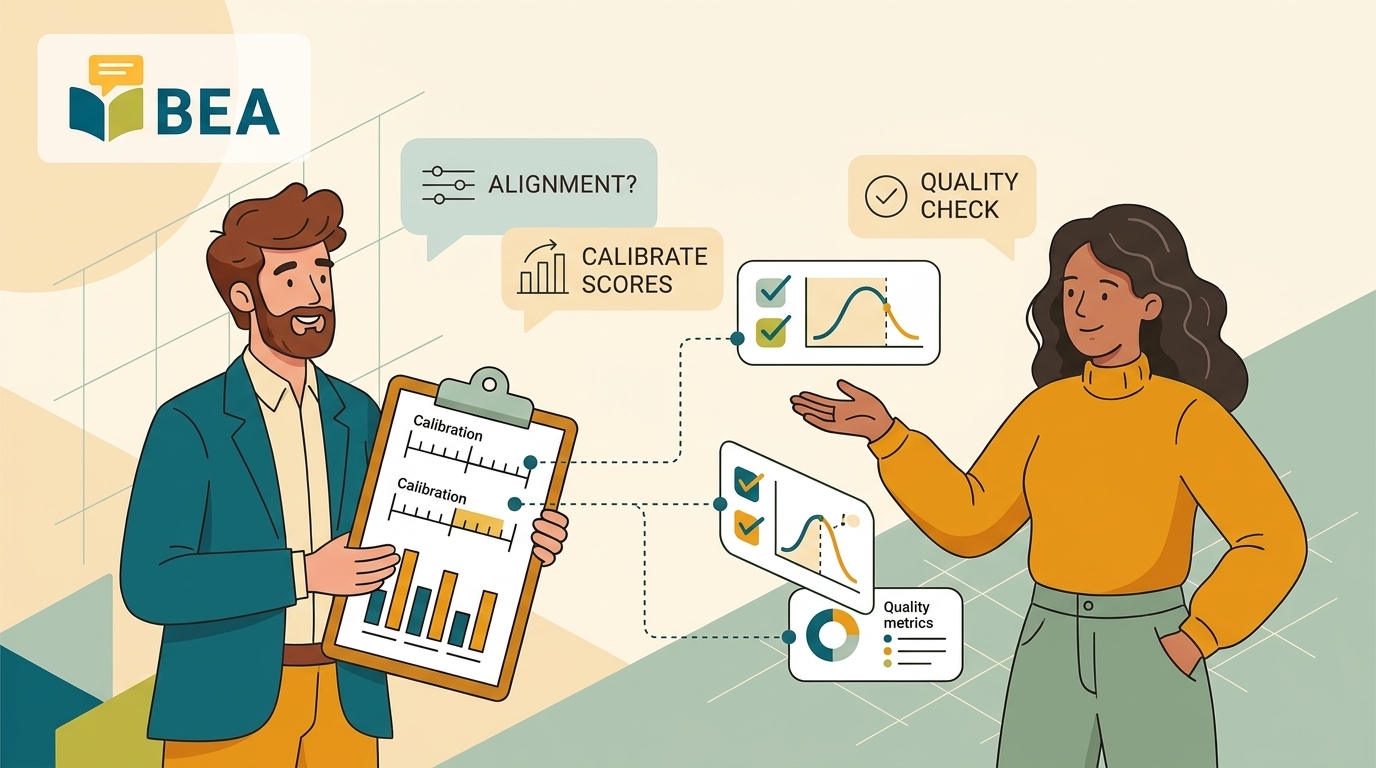
Employers and recruiters rely on English assessments to make real hiring decisions. That means the quality of every question, and every score, matters enormously. BEA assessment score calibration is the process that transforms raw test performance into a meaningful, defensible result. Understanding it helps both candidates and commissioning organisations trust what they receive. This article explains how BEA builds its question bank, how scores align to international standards, and how to distinguish a legitimate assessment from the many imitation tests circulating online in 2026.
The stakes are higher than many candidates realise. A poorly constructed test can misrepresent a candidate’s true ability, costing them a job opportunity they genuinely deserve. Equally, an uncalibrated score gives employers a false picture of workforce readiness.
Who Designs BEA Test Items and What Qualifications They Hold
Every question in the BEA question bank begins with a qualified item writer. BEA works with applied linguists and language testers who hold postgraduate qualifications in language assessment, TESOL, or related fields. These specialists follow established item-writing protocols used across the professional testing industry.
In practice, each draft item passes through multiple review stages before it enters the live bank. A content review checks linguistic accuracy and cultural fairness. A bias review ensures no item disadvantages a particular group of candidates unfairly. Finally, a technical review evaluates whether the item discriminates effectively between proficiency levels.
Furthermore, BEA piloting procedures expose new items to representative candidate samples before those items contribute to scored results. This approach mirrors the standards described by the Association of Language Testers in Europe (ALTE), which publishes guidelines on fair and valid language assessment practice. Items that perform inconsistently are revised or removed entirely.
Consequently, the question bank you encounter during your BEA test is not assembled casually. Every item has a documented quality history. As a result, the resulting score is far more reliable than any quiz assembled without formal review.
BEA Assessment Score Calibration Against CEFR Benchmarks
The Common European Framework of Reference for Languages (CEFR) is the internationally recognised standard for describing language ability. It runs from A1 (beginner) to C2 (mastery). BEA assessment score calibration maps candidate performance directly onto this scale. Therefore, a score is immediately interpretable by any employer familiar with CEFR levels.
Calibration uses statistical modelling to link item difficulty to candidate ability on a single, shared scale. In practice, this means BEA can compare a candidate tested in January 2026 with one tested in June 2026, even if they sat slightly different item sets. The scores remain comparable because the underlying scale — not the raw score count — determines the result.
For example, research published by the Council of Europe confirms that CEFR-aligned assessments significantly improve the consistency of hiring decisions across multilingual workplaces. When a recruiter sees a BEA result showing B2 proficiency, they can act on that information with confidence.
However, calibration is not a one-time exercise. BEA reviews its scoring models regularly, incorporating new candidate data to maintain accuracy as the question bank evolves. This continuous process is what separates a professionally maintained assessment from a static online quiz.
You can explore how BEA structures its assessments and review sample reporting formats directly at BEA English Assessment.
What Score Validation Looks Like Before a Result Is Released
Score validation is the checkpoint between a completed test and a delivered result. Before BEA releases any score, automated quality checks verify that the candidate’s response patterns are consistent. These checks also confirm that no technical anomalies affected the session.
In addition, BEA applies standard-setting procedures that confirm score boundaries — for example, the threshold separating B1 from B2 — remain accurately placed. These boundaries draw on both expert judgement and empirical candidate data. According to the Council of Europe’s language policy division, rigorous standard-setting is essential for any assessment claiming CEFR alignment. You can read the framework documentation at coe.int/en/web/common-european-framework-reference-languages.
Moreover, BEA assessment score calibration underpins these boundary decisions directly. This ensures each threshold reflects current candidate performance data rather than outdated assumptions. Notably, validated scores carry a verification trail. Employers and agencies commissioning BEA results can confirm the authenticity of any certificate they receive. This audit capability protects candidates from fraudulent result manipulation and gives organisations the confidence to act on what they see.
Five Structural Differences Between BEA and Fake Online English Tests
Imitation English tests have proliferated online in 2026. Spotting them protects both candidates and the organisations relying on results. Here are five structural differences to watch for.
1. No qualified item authors. Fake tests rarely disclose who wrote the questions. BEA item writers hold verifiable academic credentials.
2. No CEFR calibration. A percentage score without a CEFR level is not internationally benchmarked. BEA assessment score calibration produces a level, not just a number.
3. No bias or fairness review. Imitation tests skip the review stages that protect diverse candidates. By contrast, BEA applies documented fairness protocols at every stage.
4. No score verification. Fake results cannot be independently authenticated. Meanwhile, BEA provides employer-facing verification tools.
5. No continuous quality monitoring. Static quizzes do not update their scoring models. BEA reviews calibration data on an ongoing basis.
How to Get Started with Your BEA Assessment
If your employer or recruiter has asked you to complete an English assessment, starting in the right place matters. Taking a test on an unofficial platform means your result carries no professional weight. It may not be accepted by the organisation that requested it.
Therefore, visit BEA English Assessment — the only official platform where your score is built, validated, and verified. The process is straightforward: you register, complete the assessment under secure conditions, and receive a CEFR-aligned result that employers can trust.
Conclusion: Why Score Calibration Defines the Value of Your Result
A test score is only as meaningful as the process behind it. BEA assessment score calibration is built on qualified item design, continuous CEFR alignment, and rigorous pre-release validation. In turn, this ensures that every result reflects genuine language ability. For candidates, that means fair recognition of your skills. For employers and recruiters, it means decisions grounded in evidence, not guesswork.
Take your BEA English Assessment directly and securely at beaenglish.co.uk — the only official platform where your score is built, validated, and verified.