
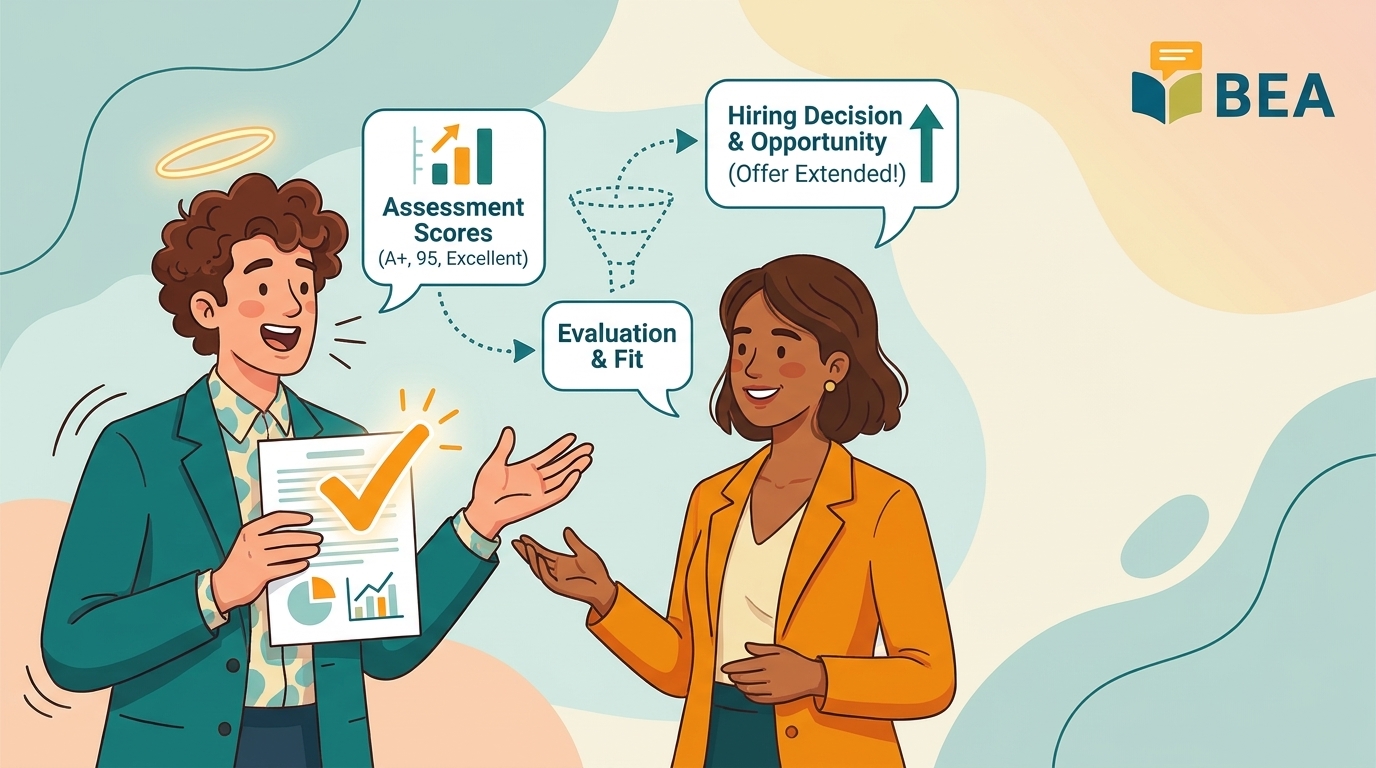
You submitted your CV, passed the initial screen, and now you face an English assessment. What actually happens next? Understanding how recruiter English assessment decisions work gives you a genuine edge — before you even reach the interview stage.
In 2026, language verification has moved from a nice-to-have to a standard recruitment checkpoint. Employers across finance, healthcare, logistics, and professional services now require documented proof of English proficiency. Knowing what recruiters do with that proof changes how you should approach the test.
Where English Assessment Sits Inside a Modern Recruitment Workflow
Most hiring funnels follow a predictable sequence: application, shortlisting, assessment, interview, and offer. English testing typically arrives at the shortlisting stage, acting as a filter before recruiters invest time in live interviews.
In practice, this placement is deliberate. Recruiters use the score to create a ranked shortlist. Candidates who meet the threshold move forward automatically. Those who fall below it may be deferred or declined before a human ever reviews the full application.
For example, a logistics firm hiring 40 warehouse supervisors might receive 600 applications. An automated recruiter English assessment workflow narrows that pool to 180 within 48 hours, based on score alone.
Furthermore, assessment providers increasingly integrate results directly into applicant tracking systems (ATS). Your score appears alongside your CV as a verified data point — not a self-reported claim. According to the Chartered Institute of Personnel and Development’s 2026 Resourcing and Talent Planning Report, over 60% of UK employers now use structured skills assessments as part of early-stage screening.
Recruiter English Assessment Decisions: What Specific Scores Signal
Score interpretation varies by role, but clear patterns exist. Recruiters typically set a minimum threshold (the cut-off score below which no candidate advances) and a preferred band (the score range that triggers immediate progression).
However, the threshold is rarely one-size-fits-all. A customer-facing sales role may demand a higher written and verbal score than a data-entry position. Recruiters calibrate cut-offs during the job briefing stage, often in consultation with the hiring manager.
Notably, a score just above the threshold does not guarantee progression. Recruiters also examine how a candidate performed across individual skill areas — reading, writing, listening, and grammar. A strong overall score with a weak written component raises a flag for roles requiring email communication or report writing.
By contrast, a candidate who scores consistently across all four skills signals reliability. That consistency tells the recruiter the result reflects genuine ability rather than a single lucky section. These recruiter English assessment decisions often come down to skill-area patterns as much as the headline score.
How HR Teams Weigh Assessment Results Alongside Interviews and References
Assessment scores rarely operate in isolation. HR teams treat them as one verified data point within a wider evidence base. That base includes structured interview performance, references, and sometimes a trial task.
In addition, many organisations apply a weighted scoring model. The English assessment might account for 25–30% of a shortlisting decision, with the structured interview carrying 50% and references the remainder. This approach stops a single test from disqualifying otherwise strong candidates unfairly.
That said, the assessment carries particular weight in regulated industries. Healthcare providers and financial services firms face compliance obligations around staff communication standards. In those contexts, a failed or low assessment can override a strong interview performance entirely.
Recruiter English assessment decisions in these sectors are therefore less flexible. BEA English Assessment produces a detailed score report that HR teams can reference at every decision point — shortlisting, offer, and onboarding. The report breaks down performance by skill, giving recruiters a clear, documented rationale for their decisions.
Common Recruiter Questions About Accepting Different Proficiency Tests
Recruiters frequently ask whether one test can substitute for another. The short answer is: it depends on what the employer specified.
Many organisations now name the specific assessment they accept in their job brief. If the brief specifies BEA, submitting a different provider’s certificate may not meet the requirement. This is true even if the proficiency level appears comparable.
Consequently, candidates should check the job specification carefully before booking any test. When recruiter English assessment decisions depend on a named provider, using a different certificate creates avoidable delays. Commissioning recruiters should state the accepted assessment clearly at the vacancy stage to prevent confusion.
Getting Started: Take the Assessment Before Your Next Application
Preparation matters. If you know an employer is likely to request English verification, completing the assessment in advance means you arrive at every application stage with a verified score already in hand.
Visit BEA English Assessment to book your test, review the format, and understand exactly what your score report will show. Recruiters value candidates who demonstrate proactive, verifiable readiness.
Conclusion
Recruiter English assessment decisions shape hiring outcomes at speed and scale. Understanding where your score sits in the funnel, what it signals, and how HR teams use it removes uncertainty from the process. Understand exactly what recruiters see when they review your score — take the BEA English Assessment at beaenglish.co.uk and walk into every hiring stage with verified proof of your proficiency.