
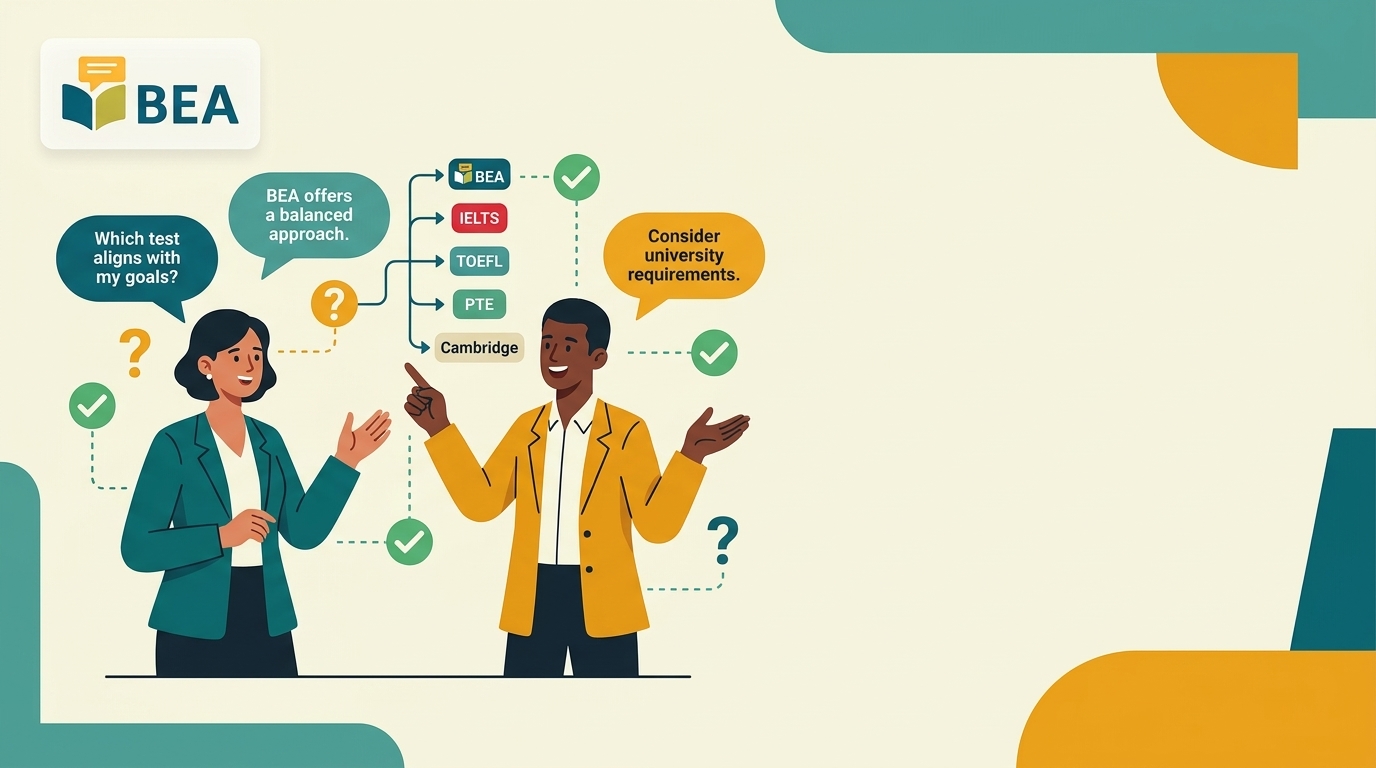
Choosing the right English proficiency test in 2026 can feel overwhelming. Employers, recruiters, and candidates all face the same question: which assessment actually fits the situation at hand? A thorough BEA vs TOEFL comparison — alongside IELTS, PTE Academic, Cambridge English, and Duolingo — reveals that no single test works for every scenario. Understanding the differences upfront saves time, money, and unnecessary stress.
In 2026, English assessment is no longer a one-size-fits-all market. Workplace-focused tests, academic gateway tests, and quick digital checks each serve distinct purposes. Furthermore, this article breaks down each option clearly so you can make a confident, informed choice.
60-Second Comparison Table: BEA vs IELTS vs TOEFL vs PTE Academic vs Cambridge English vs Duolingo English Test
| Test | Primary Purpose | Format | Typical Turnaround | CEFR Aligned? | |—|—|—|—|—| | BEA | Employer/recruiter assessment | Online, on-demand | Same day | Yes | | IELTS | Academic & immigration | Paper or computer | 3–5 days | Yes | | TOEFL iBT | Academic admission (US-focused) | Computer-based | 4–8 days | Partial | | PTE Academic | Academic & visa | Computer-based | 1–5 days | Yes | | Cambridge English | Academic & professional | Paper or computer | 2–8 weeks | Yes | | Duolingo English Test | University admission, informal | Online, adaptive | 2 days | Partial |
The BEA vs TOEFL comparison is particularly instructive for workplace scenarios. TOEFL iBT targets academic admission, primarily for US universities, and takes up to eight days to return results. BEA English Assessment, by contrast, delivers a CEFR-aligned score report on the same day — a decisive advantage for fast-moving recruitment.
Meanwhile, Cambridge English qualifications can take up to eight weeks to process. For an employer needing a candidate assessment before a contract start date, that timeline is simply unworkable.
BEA vs TOEFL Comparison: Which Test Makes Sense for Your Scenario?
Different scenarios call for different solutions. In practice, here is a practical guide based on the most common situations in 2026.
Scenario 1 — Employer or recruiter needs a fast candidate check. BEA English Assessment is purpose-built for this. It delivers a standardised, CEFR-aligned result that hiring managers can act on immediately. In fact, the assessment requires no third-party test centre and no lengthy booking process.
Scenario 2 — Applying to a UK or international university. IELTS or PTE Academic remain the most widely accepted options for higher education entry. According to the British Council, IELTS is accepted by over 11,500 organisations worldwide in 2026, making it the dominant academic gateway test.
Scenario 3 — Applying for a US graduate programme. TOEFL iBT is the traditional choice for US university admission. However, as a further BEA vs TOEFL comparison point, TOEFL scores carry limited relevance in a UK employment context.
Scenario 4 — Quick informal skills check for low-stakes roles. Duolingo English Test offers speed and low cost. However, many regulated employers and professional bodies do not yet accept it for compliance purposes.
Scenario 5 — Professional certification for a regulated sector. Cambridge English B2 First or C1 Advanced remain strong choices for formal professional credentials. That said, turnaround times and costs are higher than workplace-focused alternatives.
Cost, Format, and Turnaround: Key Differences at a Glance
Cost varies significantly across these assessments. In 2026, IELTS fees in the UK typically range from £185 to £220. TOEFL iBT costs approximately $235 (around £185 at current rates). Cambridge English exams range from £150 to £220 depending on level. PTE Academic sits around £175. Duolingo English Test costs approximately $65 (around £52).
By contrast, BEA English Assessment offers employers and recruiters a cost-effective, scalable solution without requiring candidates to book a public test centre. Consequently, this makes the BEA vs TOEFL comparison particularly compelling for high-volume recruitment programmes.
Format also matters. TOEFL iBT is a four-hour computer-based exam. Meanwhile, BEA operates entirely online and on demand, meaning candidates complete it at a time that suits both them and the commissioning organisation.
You can explore pricing and registration options directly at BEA English Assessment — the platform is designed for both individual candidates and corporate clients.
Frequently Asked Questions About Choosing Between These Tests
Is the BEA accepted for UK visa applications? No. UK visa and immigration routes specify UKVI-approved IELTS or SELT providers. BEA English Assessment serves employer and recruiter needs, not immigration compliance.
How does BEA vs TOEFL differ for HR teams? TOEFL targets academic admission and returns results in four to eight days. In addition, BEA delivers same-day CEFR-aligned results specifically designed for workplace assessment, with no test centre logistics required.
Can a candidate self-register for BEA? Yes. Candidates can register directly, or employers and recruiters can commission assessments at scale through the BEA platform.
Does BEA test all four language skills? BEA assesses the core competencies relevant to professional communication. Therefore, candidates receive a clear CEFR level — A1 through C2 — that employers can benchmark against role requirements.
Is CEFR alignment important for employers? Absolutely. CEFR (Common European Framework of Reference for Languages) provides a universally understood benchmark. Notably, it allows employers across sectors to compare candidates objectively, regardless of which country they trained in.
Getting Started with BEA English Assessment in 2026
If you are a candidate completing BEA at the request of an employer or recruitment agency, the process is straightforward. Register, complete the online assessment, and receive your CEFR-aligned score report — all without visiting a test centre or waiting days for results.
As a result, if you are an employer or recruiter, BEA offers a scalable, professional solution for screening English proficiency at any stage of the hiring cycle. The platform removes third-party complexity and puts results directly in your hands.
Visit BEA English Assessment to register or commission assessments for your organisation today.
Conclusion
In 2026, the right English test depends entirely on your scenario. Academic routes favour IELTS or TOEFL; professional workplace assessment is where BEA excels. The BEA vs TOEFL comparison makes clear that speed, CEFR alignment, and employer focus set BEA apart from academic-gateway tests. Ready to take the next step? Visit https://beaenglish.co.uk to register directly and receive your CEFR-aligned score report — no third-party involvement required.