
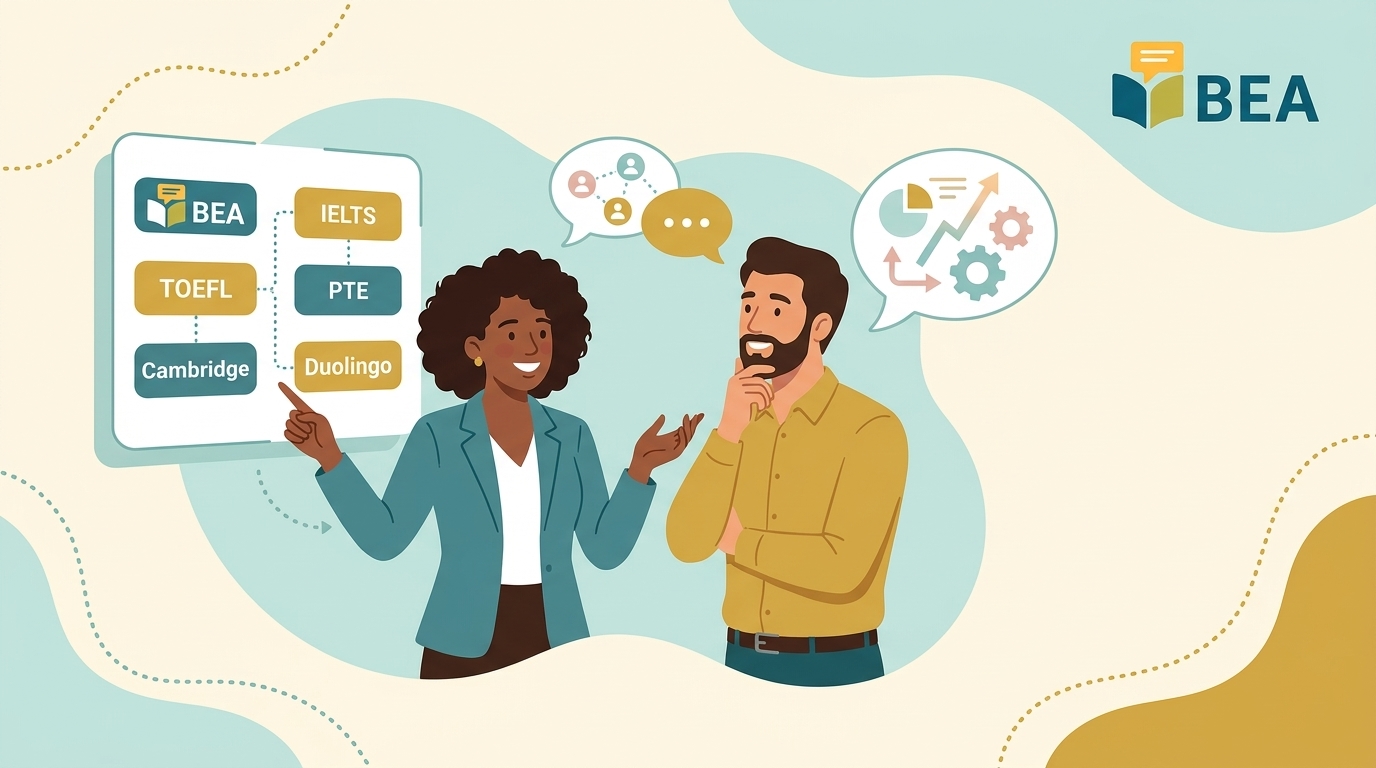
Choosing the right English proficiency test can directly affect your job offer timeline. In 2026, employers and recruitment agencies accept a wider range of assessments than ever before — yet each test serves a different purpose. A thorough BEA vs IELTS comparison reveals that no single solution fits every candidate or hiring situation.
This guide places six major assessments side by side. Whether you are a candidate preparing for a workplace role or an HR manager commissioning a pre-employment screen, you will find clear, evidence-based guidance below.
60-Second Summary Table: BEA, IELTS, TOEFL, PTE Academic, Cambridge English, and Duolingo Side by Side
The table below compares the six most commonly discussed tests across the dimensions that matter most to employers and job seekers in 2026.
| Test | Primary Purpose | Format | Typical Cost | Result Turnaround | CEFR-Aligned | |—|—|—|—|—|—| | BEA | Workplace pre-employment | Online, on-demand | Lower cost | Same day | Yes | | IELTS | Academic & immigration | Paper or computer | £185–£220 | 3–13 days | Yes | | TOEFL iBT | Academic admission | Computer-based | $185–$245 | 4–8 days | Yes | | PTE Academic | Academic & migration | Computer-based | £170–£200 | 1–5 days | Yes | | Cambridge English | General & academic | Paper or computer | £130–£220 | Up to 8 weeks | Yes | | Duolingo English Test | University admission | Online | $65 | 2 days | Partial |
In practice, most of these tests target academic institutions or immigration authorities. The BEA vs IELTS comparison is therefore most useful for employment contexts, where turnaround speed and workplace relevance matter more than a globally recognised academic credential.
Notably, according to the British Council, over 11,000 organisations worldwide accept IELTS — yet the majority are universities and visa bodies, not direct employers screening frontline staff. This distinction shapes which test you should choose.
BEA vs IELTS Comparison: Which Test Fits Your Situation?
Selecting the right test depends on your specific goal. Consider the following scenarios carefully.
You need a job offer confirmed within days
Consequently, if your employer or agency needs a verified language result before issuing a contract, waiting three to eight weeks for a Cambridge result is not realistic. BEA delivers a same-day, CEFR-aligned result. Recruiters can commission the assessment directly and receive the verified score without delay.
You are applying to a university or professional visa programme
However, academic institutions and Home Office immigration routes typically require IELTS, TOEFL, or PTE Academic. In those cases, BEA is not the appropriate choice. Choose IELTS or PTE Academic for their wide institutional recognition in immigration and education contexts.
Your employer has asked you to take a specific test
In practice, many employers now specify BEA precisely because it focuses on workplace communication rather than essay writing or academic listening tasks. If your recruiter has directed you to BEA English Assessment, follow that instruction — it reflects a deliberate hiring decision.
You are an HR manager or recruiter designing a screening process
Furthermore, the BEA vs IELTS comparison becomes especially important here. IELTS costs candidates up to £220 and requires test-centre attendance. BEA reduces friction, lowers candidate drop-off rates, and delivers results your team can act on the same day.
Frequently Asked Questions: Cost, Format, Turnaround, and Employer Recognition Explained
How much does each test cost in 2026?
IELTS typically costs between £185 and £220 in the UK. TOEFL iBT ranges from $185 to $245. PTE Academic sits at approximately £170 to £200. Cambridge English varies by level, from £130 to £220. Duolingo charges $65. By contrast, BEA is available at a significantly lower price point, making it accessible for volume recruitment campaigns.
What format does BEA use?
BEA is a fully online, on-demand assessment. Candidates complete it from any device without booking a test centre. The format assesses reading, listening, and language use in contexts directly relevant to workplace communication.
Do UK employers recognise BEA?
Yes. BEA produces CEFR-aligned results — the Common European Framework of Reference for Languages, the internationally accepted standard for describing language proficiency. Moreover, employers and agencies who commission BEA understand exactly what a B2 or C1 result means in practical terms. You can learn more about the assessment methodology at BEA English Assessment.
Is Duolingo accepted by UK employers?
That said, Duolingo is primarily accepted by certain universities, particularly in North America. Most UK employers and recruitment agencies do not reference Duolingo results in their hiring criteria for 2026. Its partial CEFR alignment also limits comparability.
How quickly will I receive my result?
BEA delivers results the same day. PTE Academic typically takes one to five days. IELTS computer-based results arrive within three to five days, while paper-based IELTS can take up to thirteen days. Meanwhile, Cambridge English results can take up to eight weeks, making it unsuitable for urgent hiring decisions.
Getting Started: Practical Next Steps for Candidates and Recruiters
If you are a candidate, confirm with your employer or agency which test they require. If they have specified BEA, you can purchase and complete the assessment immediately without scheduling delays or test-centre travel.
Therefore, if you are a recruiter or HR manager, consider how the BEA vs IELTS comparison aligns with your hiring timeline. IELTS remains appropriate for roles with regulatory language requirements — for example, certain healthcare registrations. However, for standard employment screening, BEA removes unnecessary cost and waiting time from your pipeline.
For candidates and employers alike, the key question is fitness for purpose. Academic tests measure skills that academic institutions value. In practice, BEA measures what workplace communication actually demands.
Conclusion: Make the Right Choice for Your Employment Goal
In 2026, the BEA vs IELTS comparison is ultimately about context. IELTS, TOEFL, PTE Academic, Cambridge English, and Duolingo each serve specific purposes — most of them outside direct employment screening. BEA is designed from the ground up for workplace contexts, delivering verified CEFR results fast.
Ready to take the workplace-focused option? Purchase BEA directly at BEA English Assessment and receive your verified CEFR-aligned result the same day.
Source: British Council IELTS global recognition data — https://www.britishcouncil.org/exam/ielts