
Thousands of candidates sit a workplace English test each year without fully understanding what they will face. That uncertainty creates unnecessary stress and, in some cases, underperformance. Having the BEA assessment sections explained clearly before test day makes a measurable difference to your confidence and your result.
The BEA English Assessment is an online English proficiency test commissioned by employers and recruitment agencies. It measures real-world language ability across several distinct modules. This article walks you through each one — what it tests, how performance is judged, and what happens after you click submit.
BEA Assessment Sections Explained: A Plain-English Overview of Each Module
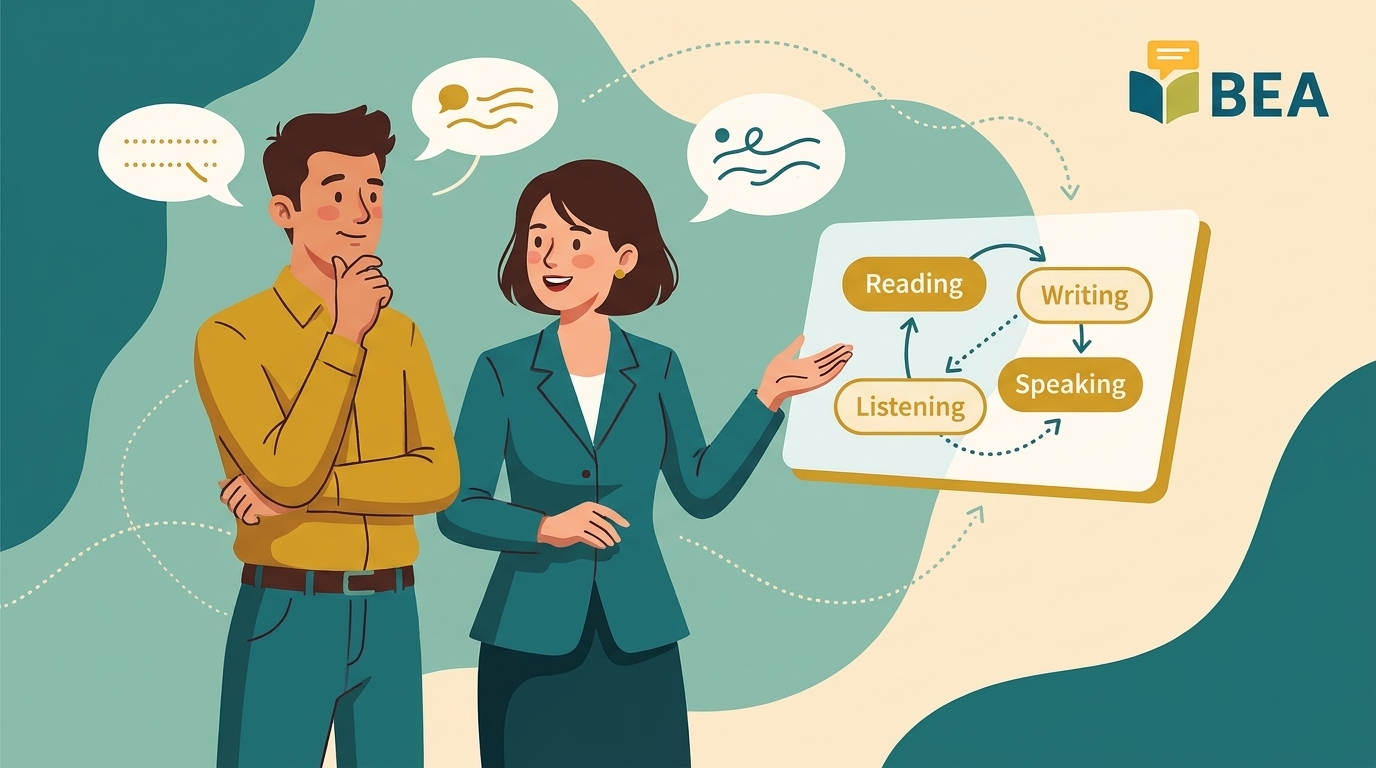
The BEA assessment sections explained simply: the test covers reading, writing, listening, and grammar in a structured online format. Each module reflects the kind of English you would use in a professional workplace, not abstract academic exercises.
Reading presents you with workplace-style texts — emails, reports, notices — and asks comprehension questions. The goal is to measure whether you extract meaning accurately under realistic conditions.
Writing tasks require you to produce a short professional response, such as a reply to a work email or a brief summary. For example, you might receive a memo and write a response as if addressing a colleague.
Listening presents audio recordings of workplace conversations or announcements. You answer questions that test whether you understand spoken English in professional contexts. According to the British Council’s 2026 English at Work global research, listening comprehension is one of the skills employers most frequently cite as critical for workplace effectiveness.
Grammar and vocabulary tasks assess your command of everyday professional language — tense, agreement, word choice, and sentence structure. In practice, these questions mirror the kind of editing and proofreading decisions you make when composing professional documents.
Together, these modules give employers a rounded picture of your English ability across all four communication channels. More importantly, having the BEA assessment sections explained in advance means you can approach each module with a clear strategy rather than guessing what comes next.
What Skills Does Each Section Measure — and How Is Performance Judged?
Understanding what each module scores is as important as knowing what it covers. The BEA assessment sections go beyond right-or-wrong answers. Each module uses a scaled scoring system aligned to the Common European Framework of Reference for Languages (CEFR) — the internationally recognised standard that runs from A1 (beginner) to C2 (mastery).
Reading is scored on accuracy and inference. You need to identify both explicit information and implied meaning. However, the test does not reward guessing — precision matters.
Writing is assessed on clarity, structure, relevance, and grammatical accuracy. A response that communicates clearly but contains minor errors can still score well. By contrast, a technically perfect response that misses the task requirements will score lower.
Listening is marked on accuracy. The recordings use natural speech pace and include mild accents to reflect real workplace environments. In addition, some questions test your ability to identify the speaker’s purpose or tone, not just factual content.
Grammar and vocabulary tasks are machine-scored against a fixed answer key. Speed is not measured — accuracy is the only variable. Furthermore, the difficulty level adapts to match the range of CEFR levels, so the assessment is equally relevant whether you are working towards B1 (intermediate) or aiming for C1 (advanced professional fluency). Consequently, the BEA assessment sections explained here apply equally to candidates at very different starting points.
You can find full details about the scoring methodology and CEFR alignment on the BEA English Assessment website.
What Happens After You Submit: Timing, Results, and What Employers Receive
Notably, one of the most common candidate questions is: “How quickly will I get my result?” The BEA assessment generates a score report promptly after submission. You do not wait days for a manual marking process.
Your employer or recruitment agency receives a verified score report linked to your profile. The report shows your performance across each module and your overall CEFR level. As a result, recruiters can make informed, evidence-based decisions without relying on guesswork.
The report you receive is equally yours to share. Many candidates use their BEA result as a portable credential when applying for future roles. Therefore, taking the assessment once can provide value well beyond a single job application.
How to Prepare and Register
With this in mind, preparation is straightforward once you know what to expect. Review the module structure, practise reading professional texts, and listen to workplace English audio where possible. Meanwhile, formal study programmes are not required — consistent exposure to workplace English is the most effective preparation. That said, candidates who take time to review the BEA assessment sections explained in this article consistently report feeling more confident on test day.
Visit BEA English Assessment to register, complete your assessment online at your own pace, and receive your verified score report.
Conclusion
The BEA assessment sections explained across this article show a test designed for practical, professional English — not abstract academic exercises. Each module measures skills that employers genuinely need, and the CEFR-aligned report gives both you and your employer a credible, comparable result. Ready to understand exactly what you will face on test day? Visit beaenglish.co.uk to register, complete the BEA assessment at your own pace, and receive a verified score report you can share with any employer.