
Knowing exactly what an assessment measures before you sit it is not just reassuring — it is strategic. Many candidates arrive at English proficiency tests unsure of the format, the timing, or the skills being evaluated. Having the BEA assessment sections explained clearly in advance allows you to prepare with purpose rather than anxiety.
The BEA (Business English Assessment) is a standardised, online English language test. Employers and recruitment agencies across the UK use it to verify a candidate’s real-world language capability. Whether you have been asked to take it by a recruiter or an HR team, understanding the structure helps you perform at your genuine level.
This article walks you through every stage: from registration to results.
BEA Assessment Sections Explained: Registration, Setup, and Identity Checks
Before any testing begins, you complete a straightforward registration process. You create an account, pay the one-time £99 fee, and receive access to the BEA platform. Furthermore, the entire process happens online, with no need to attend a test centre.
Identity verification is a key part of this stage. You will be asked to confirm your identity before beginning. This protects the integrity of your result. Consequently, employers and recruiters trust BEA scores precisely because the process is secure and independently administered.
In practice, the platform itself is designed for accessibility. You need a stable internet connection, a modern browser, and a quiet environment. The assessment does not rush you unduly, but it does require focused, uninterrupted attention.
Notably, research from the British Council confirms that employer confidence in English assessments rises significantly when identity verification and remote proctoring are standard features. BEA builds both into its workflow from the outset.
Inside the Test: A Section-by-Section Breakdown of What Each Part Measures
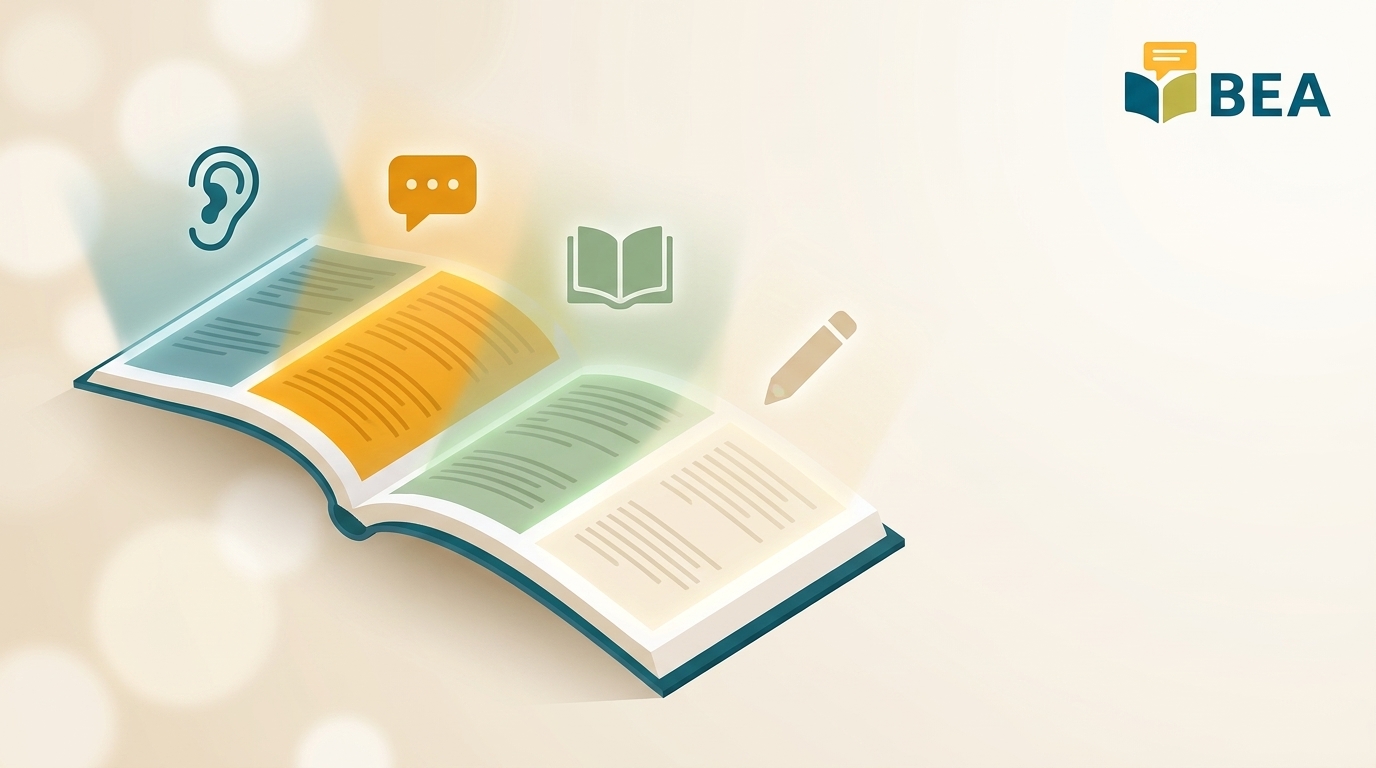
This is the heart of the BEA assessment sections explained. The assessment is divided into distinct components, each targeting a different dimension of English proficiency.
Reading Comprehension
The reading section presents authentic business-style texts. You answer questions that test your ability to identify main ideas, infer meaning, and understand vocabulary in context. In addition, this mirrors real workplace tasks such as processing reports or client correspondence.
Grammar and Language Structure
Here, the assessment measures your command of English grammar at a functional level. Tasks include sentence completion, error identification, and structure selection. That said, the goal is not academic pedantry — it is practical accuracy in professional communication.
Vocabulary in Use
For example, this section might ask you to select the most appropriate term for a workplace scenario. It tests whether you understand not just word meanings but register. Knowing when formal language is required versus conversational phrasing matters greatly in professional settings.
Listening Comprehension
You listen to short audio clips drawn from business contexts: meetings, telephone calls, or workplace announcements. Questions test your ability to follow spoken English at a natural pace. More importantly, this is one of the most valued sections for employers hiring for client-facing roles.
Writing Skills
The writing component asks you to produce short written responses. These are assessed against CEFR criteria — the Common European Framework of Reference for Languages. This internationally recognised scale runs from A1 beginner to C2 mastery. Therefore, to understand how the BEA assessment sections explained here map to those CEFR levels, candidates should review the scoring guidance on the platform before sitting the test.
You can explore the full platform and understand each component before you begin by visiting BEA English Assessment at beaenglish.co.uk.
After You Submit: Score Reports, CEFR Levels, and What Comes Next
Once you complete the assessment, your results generate a detailed score report. This report does not simply assign a pass or fail. Instead, it maps your performance across each section to a corresponding CEFR level.
Meanwhile, employers receive a nuanced picture of your English ability. A recruiter can see, for instance, that a candidate performs at B2 in reading but at C1 in listening. That granularity helps businesses make better-informed hiring decisions.
Candidates also receive their own copy of the results. Your score belongs to you. As a result, you can share it with multiple employers, include it in applications, or use it to demonstrate professional development over time.
The BEA score report therefore functions as a verifiable, portable credential — not just a one-use document for a single job application.
Getting Started with Your BEA Assessment
If you have been asked to take the assessment by an employer or agency, the next step is simple. Head to BEA English Assessment, register your account, and pay the £99 fee directly on the platform. No third-party booking agents are required.
By contrast, candidates who attempt similar assessments without preparation often report uncertainty about format and timing. However, candidates who have the BEA assessment sections explained to them in advance consistently report feeling more confident going in. Preparation is not about gaming the test — it is about knowing where to direct your effort.
Conclusion: Your Results, Your Evidence
The BEA assessment sections explained across this article cover everything from initial registration through to a CEFR-mapped score report. Each section targets a distinct and professionally relevant skill, and your results provide clear, shareable evidence of your English level.
Ready to take the next step? Visit BEA English Assessment at beaenglish.co.uk to register, pay your £99 fee, and complete your assessment on the official platform today.