
Many candidates arrive at an English language assessment without a clear picture of what lies ahead. Understanding the BEA assessment sections explained in full — before you begin — removes anxiety and helps you perform at your genuine level. This article walks you through every stage, from registration to receiving your results.
Whether you are completing the BEA at the request of an employer or a recruitment agency, clarity about the process is valuable. Knowing what each section measures, and what your score communicates to a hiring organisation, puts you in a far stronger position.
Before You Begin: Registering and Preparing on beaenglish.co.uk
Registration is straightforward and takes only a few minutes. You visit BEA English Assessment at beaenglish.co.uk, create your candidate profile, and receive access to the assessment platform immediately. No third-party site is involved at any point.
In practice, many candidates are directed here by their employer or recruiter, who may have already set up a company account. However, you complete the test yourself, independently, as an individual. The results belong to you, and you control who receives them.
Before starting, ensure you have a stable internet connection and a quiet environment. The assessment is untimed in the sense that there is no single countdown clock across the whole test — individual question types carry their own time guidance. Preparing a distraction-free space helps you focus and reflect your true ability accurately.
Notably, according to the British Council’s 2026 English Language Impact Report, English proficiency remains one of the most consistently requested competencies in international recruitment screening. Having the BEA assessment sections explained clearly before you sit the test gives candidates a genuine competitive advantage.
BEA Assessment Sections Explained: A Section-by-Section Breakdown of What Is Measured
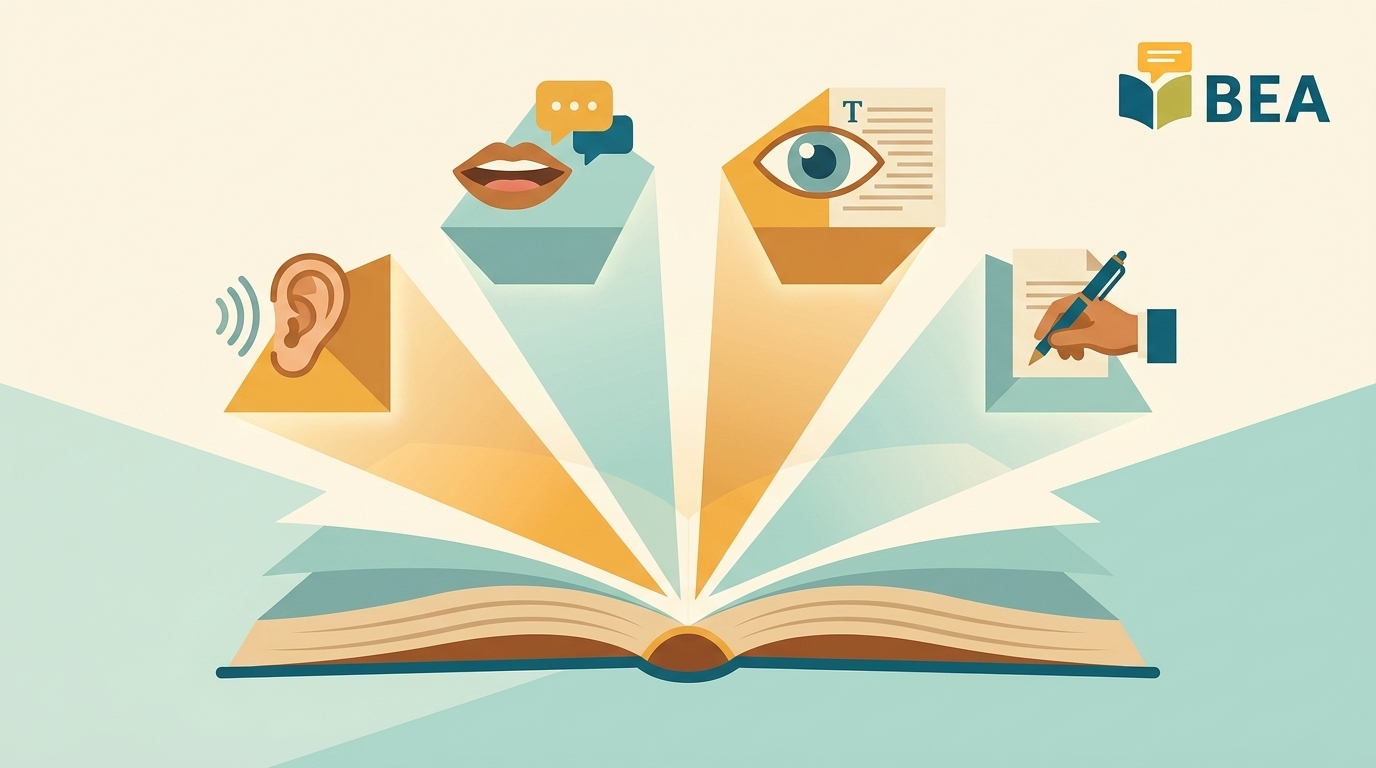
This is where the detail becomes most useful. The assessment evaluates four core language competencies: reading, writing, listening, and grammar and vocabulary. Each section isolates a specific skill set.
Reading
The reading section presents a series of written texts drawn from professional and everyday contexts. You answer comprehension questions that test your ability to identify meaning, infer intent, and understand structure. This section measures how effectively you process written English under realistic conditions.
Writing
In the writing section, you produce short written responses to prompts. These prompts simulate workplace communication tasks, such as composing a concise message or summarising information. Assessors evaluate accuracy, coherence, and appropriate register — meaning whether your tone fits the context.
Listening
The listening section plays audio clips of natural spoken English. These include conversations, instructions, and announcements. You answer questions that assess comprehension, attention to detail, and the ability to follow spoken information accurately.
Grammar and Vocabulary
For example, a candidate might encounter sentence-completion tasks, word-choice questions, or error-identification exercises. This section measures the underlying language system that supports all communication. Strong performance here typically correlates with confidence across the other three sections.
Furthermore, each section produces a sub-score. These sub-scores combine into an overall band result, aligned to the Common European Framework of Reference for Languages (CEFR) — the internationally recognised six-level scale running from A1 (beginner) to C2 (proficient). Reviewing the BEA assessment sections explained above before test day helps you approach each part with the right expectations.
After You Submit: Reading Your Score Report and Sharing Results With an Employer
Once you complete the assessment, your score report generates quickly — typically within a short processing window. The report presents your overall CEFR band alongside the individual sub-scores for each section. This granular breakdown helps employers understand not just your level, but where your specific strengths lie.
Consequently, an employer hiring for a role requiring strong written communication can look directly at your writing and grammar sub-scores. A recruiter placing candidates in client-facing roles may prioritise your listening and speaking indicators. The detailed format serves both parties efficiently.
Sharing your results is fully within your control. The platform allows you to forward your score report directly to an employer or agency from within your candidate dashboard. In addition, results carry a verifiable credential that hiring organisations can authenticate without contacting you separately.
That said, your score report also provides useful personal insight. If one section scores lower than others, you gain a clear indication of where further study would benefit you most before any future assessment.
Get Started Today
Understanding the BEA assessment sections explained here is the first practical step. The second step is completing the assessment itself, on a platform designed to make the process simple and transparent.
Conclusion
The BEA English Assessment measures reading, writing, listening, and grammar across a structured, CEFR-aligned framework. Your score report gives employers the precise, credible evidence they need — and gives you a clear picture of your own English proficiency. Ready to take the next step? Register and complete your assessment entirely at BEA English Assessment — beaenglish.co.uk, with no third-party sites and no intermediaries.