
Sitting an English assessment at your employer’s or recruiter’s request can feel daunting — especially when you do not know what to expect. This BEA assessment breakdown guide exists to change that. By the time you finish reading, you will know exactly what each section tests, how the scoring works, and what your results mean for your job application in 2026.
Preparation reduces anxiety. More importantly, it helps you perform to your actual ability rather than losing marks to unfamiliar formats. This guide walks through the full candidate journey from registration to results.
What Happens Before You Begin: Registration, Identity Steps, and Test Environment Setup
Before any questions appear on screen, you complete a short registration process. You provide your name, email address, and the reference code supplied by your employer or recruitment agency. This links your results directly to the organisation that commissioned the assessment.
In addition, the platform asks you to confirm your identity. You upload a brief photographic verification so the commissioning organisation can be confident the right person is completing the test. This step takes only a few minutes.
Furthermore, you need to check your test environment before you start. The BEA runs in a standard web browser with no specialist software to install. A stable internet connection, a quiet room, and a working microphone are all you need. According to the Office for National Statistics, 98% of UK adults aged 16–44 used the internet daily in 2026, which means most candidates already have the setup they need at home or at work.
That said, take five minutes to close unnecessary browser tabs and silence notifications before the timer begins.
The Four Core Sections: Your BEA Assessment Breakdown Guide to Task Types
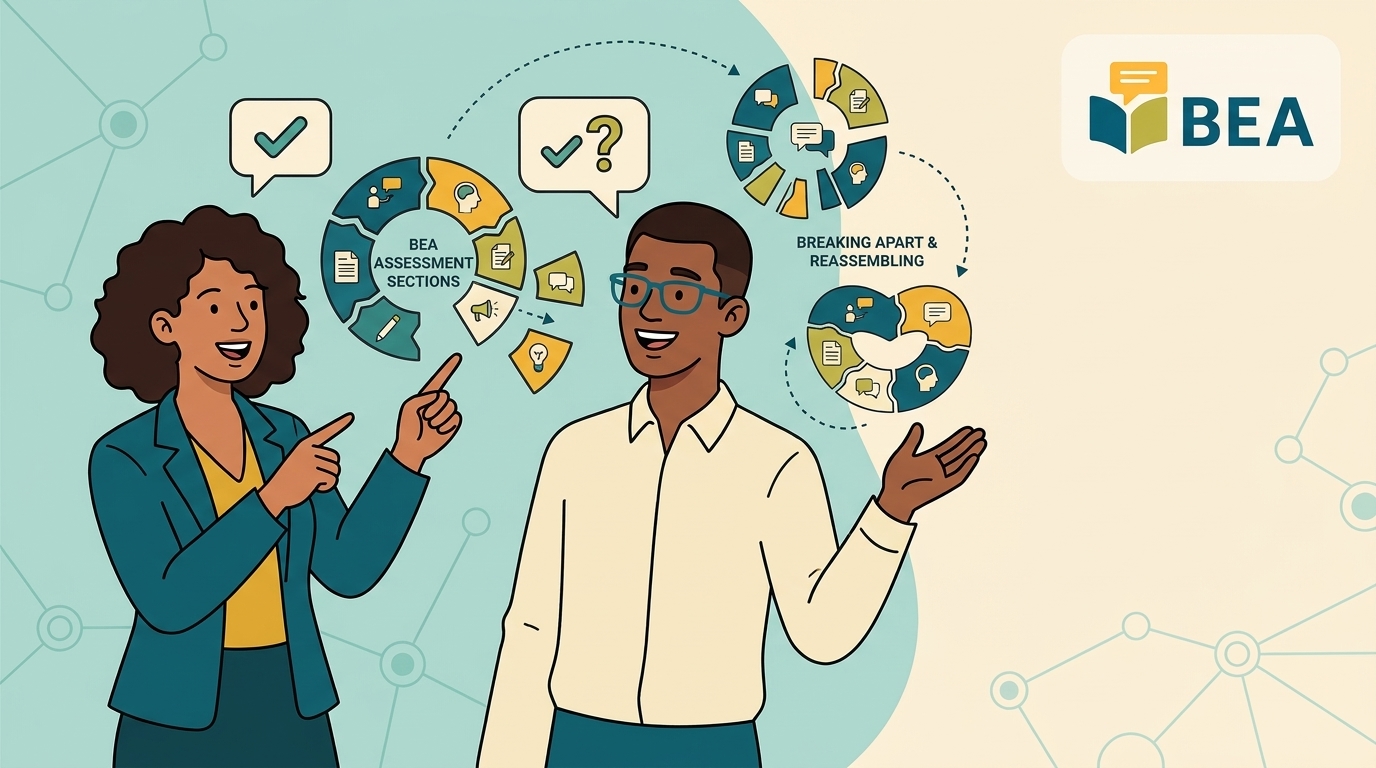
The BEA covers four skill areas: reading comprehension, grammar and vocabulary, writing, and listening. Each section targets a distinct workplace competency. Bookmark this BEA assessment breakdown guide so you can revisit the task-type descriptions as you prepare.
Reading comprehension presents you with professional texts — emails, reports, or briefing documents — followed by multiple-choice questions. Employers care about this section because employees must extract accurate information quickly from written materials every day.
Grammar and vocabulary tests your command of standard business English structures. For example, you might select the correct tense in a formal email context or choose the most precise word from a set of near-synonyms. This section reveals whether your language is reliable enough for client-facing communication.
Writing asks you to produce a short piece of text — typically a professional email or a summary paragraph. Assessors evaluate clarity, coherence, and appropriate register (the level of formality suited to the situation). Recruiters use this score to benchmark written communication skills before interview.
Listening plays an audio clip — a workplace conversation or a short briefing — and asks you to answer comprehension questions. This section matters because miscommunication in spoken English costs businesses time and money. You can learn more about how each section maps to workplace outcomes by visiting the BEA English Assessment candidate guidance pages.
After You Submit: How to Interpret Your Scores and What Comes Next
Once you submit, the platform generates your results automatically. You do not wait days for a human marker. Instead, scores appear on a clear dashboard broken into the four skill areas. This part of the BEA assessment breakdown guide is worth reading carefully, because understanding your results is just as important as completing the test itself.
Each section score aligns to the Common European Framework of Reference for Languages (CEFR) — the international standard that describes language ability from A1 (beginner) to C2 (mastery). Your report will show, for example, that your reading sits at B2 (upper-intermediate) while your writing sits at C1 (advanced). This gives employers a precise, comparable picture rather than a vague pass or fail.
Consequently, both you and your prospective employer see exactly where your strengths lie. If your score meets the employer’s benchmark, the result supports your progression through the hiring process. If one section scores lower than expected, you receive transparent data you can use to focus your development.
Getting Started: Practical Steps for Candidates
Start by confirming the reference code with your employer or recruitment agency. Then visit BEA English Assessment to create your candidate account and review the official guidance documents. The platform is available around the clock, so you can schedule the assessment at a time that suits you.
Practice your listening in English beforehand and re-read any professional emails you have written recently. These simple habits sharpen the skills the BEA measures.
Conclusion
This BEA assessment breakdown guide has covered every stage — from identity verification and environment setup, through the four scored sections, to CEFR-aligned results you and your employer can act on. Knowing the structure removes uncertainty and lets your real English ability show.
Ready to understand exactly what you are walking into? Visit BEA English Assessment to register, review the candidate guidance, and take the BEA on your own schedule.