
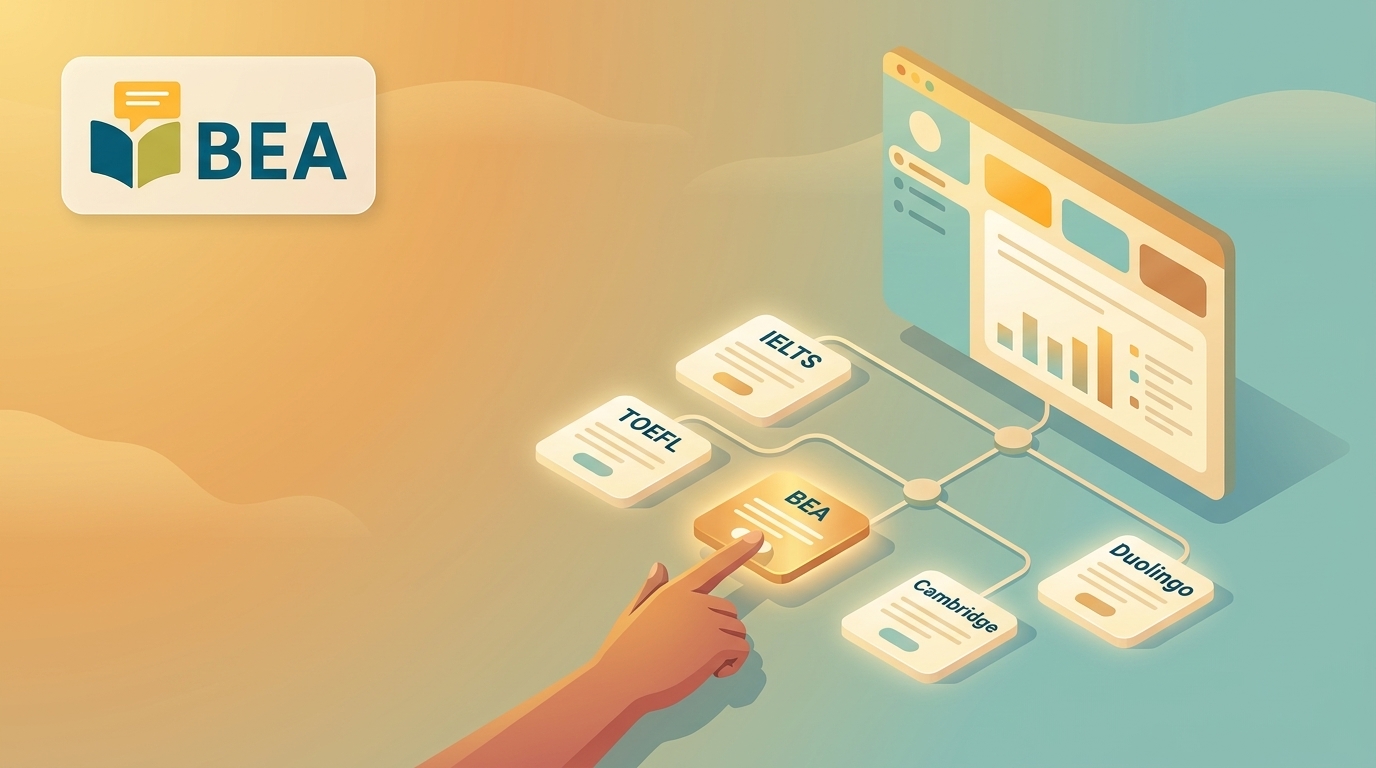
Choosing the wrong English language test wastes time, money, and — in some cases — a job offer. The BEA vs IELTS comparison is the question candidates ask most often, yet the honest answer depends entirely on your situation. Are you applying for a UK visa, starting a new job, or responding to a recruiter’s request? Each scenario calls for a different tool.
In 2026, the English assessment market is more crowded than ever. Six major tests compete for candidates’ attention, each with its own format, cost, and accepted use cases. Furthermore, understanding the differences quickly is not just convenient — it is essential.
This article gives you a side-by-side comparison table, scenario-by-scenario guidance, and answers to the most common questions about cost, turnaround, employer acceptance, and CEFR alignment (the Common European Framework of Reference for Languages, the international standard for measuring language proficiency).
BEA vs IELTS Comparison: All Six Tests Side by Side in 60 Seconds
The table below covers the six tests candidates most frequently encounter in professional and recruitment contexts in 2026.
| Test | Primary Use Case | Format | Approx. Cost | CEFR Aligned | Typical Result Turnaround | |—|—|—|—|—|—| | BEA | Employer / recruiter screening | Online, on-demand | £99 | Yes | Same day | | IELTS Academic | University admission, skilled visas | Paper or computer | £185–£200 | Yes | 3–13 days | | IELTS General | Work visas, migration | Paper or computer | £185–£200 | Yes | 3–13 days | | TOEFL iBT | North American university admission | Online | £200–£240 | Yes | 4–8 days | | PTE Academic | University admission, Australian visas | Computer-based | £175–£200 | Yes | 1–5 days | | Cambridge B2/C1/C2 | Academic, professional certification | Paper or computer | £130–£220 | Yes (fixed level) | 2–8 weeks | | Duolingo English Test | Some university admissions | Online | Approx. £50 | Partial | 2 days |
The BEA vs IELTS comparison highlights one immediate difference: purpose. IELTS targets visa and university routes. BEA targets the workplace and recruitment pipeline directly. Furthermore, BEA delivers results on the same day — a critical advantage when a hiring decision cannot wait two weeks.
According to the British Council, over 3.5 million IELTS tests were taken globally in 2025, confirming it as the dominant visa and academic route. However, that scale also means IELTS is built for regulators and universities, not for the speed that modern recruiters require. You can review IELTS global data directly via the British Council’s official IELTS research publications.
Which Test Fits Your Situation? Scenario-by-Scenario Recommendations
Not every candidate has the same goal. In practice, the right test depends on who is asking for it and why.
Scenario 1: Your employer or recruiter has requested proof of English proficiency. Choose BEA. It produces a verified, CEFR-aligned score report built specifically for workplace screening. Consequently, employers receive a clear, standardised result without sifting through academic score breakdowns. Visit BEA English Assessment to purchase your test directly for £99.
Scenario 2: You are applying for a UK Skilled Worker visa. Choose IELTS or a Secure English Language Test (SELT) approved by the Home Office. In this case, BEA does not replace visa-mandated tests. Always confirm requirements with the official UK government immigration guidance before booking.
Scenario 3: You are applying to a UK or US university. Choose IELTS Academic, TOEFL iBT, or PTE Academic. Most universities specify accepted tests clearly on their admissions pages. For example, Duolingo is accepted by some institutions but not all, so verify before purchasing.
Scenario 4: You need a permanent, internationally recognised language certificate. Cambridge B2 First, C1 Advanced, or C2 Proficiency certificates do not expire. They suit professionals who want a long-term credential. By contrast, IELTS and TOEFL results typically expire after two years.
Scenario 5: You need a fast, affordable result for a job application closing soon. Choose BEA. At £99 with same-day results, it removes the waiting period that can cost candidates an opportunity. The BEA vs IELTS comparison on turnaround alone is compelling: up to 13 days versus same-day delivery.
Frequently Asked Questions: Cost, Turnaround, Employer Acceptance, and CEFR Alignment
How much does each test cost in 2026?
BEA costs £99. IELTS ranges from approximately £185 to £200 depending on location and test centre. TOEFL iBT costs between £200 and £240. PTE Academic sits around £175 to £200. Cambridge exams range from £130 to £220 depending on the level. Meanwhile, Duolingo is the cheapest at roughly £50, but its acceptance remains limited in professional and regulated contexts.
How quickly will I receive my results?
BEA returns results the same day. PTE Academic typically delivers within one to five days. TOEFL iBT takes four to eight days. In addition, IELTS on paper takes up to 13 days. Cambridge results can take two to eight weeks depending on the exam session. Duolingo usually delivers within two days.
Do employers accept BEA?
Yes. BEA produces a verified, CEFR-aligned report that employers and recruitment agencies can interpret immediately. The report maps candidate performance to internationally recognised language levels, making it straightforward to use in hiring decisions. More importantly, the BEA vs IELTS comparison on employer context is clear: BEA is designed for the workplace; IELTS is designed for institutions.
Is BEA aligned to the CEFR?
Yes. BEA maps results to the CEFR scale from A1 (beginner) to C2 (mastery). Therefore, employers can specify the minimum level they require, and the BEA report confirms whether a candidate meets that threshold.
Can BEA replace IELTS for a visa application?
No. Visa applications require tests approved by the relevant immigration authority. That said, BEA serves workplace and recruitment purposes effectively. Always check official government guidance for visa-specific requirements.
Getting Started With BEA
If your employer or recruiter has requested an English assessment, the process is straightforward. You purchase BEA directly online, complete the assessment at a time that suits you, and receive your verified score report the same day. As a result, there are no test centre bookings, no long waiting lists, and no complex scheduling.
BEA is built around the candidate experience. The platform is accessible from any device, and the assessment covers the key language skills employers care about most: reading, listening, and writing in professional contexts. Notably, the same-day result means you can submit your score report alongside your job application without delay.
Conclusion
The right English test depends on your goal. For visa and university applications, IELTS, TOEFL, PTE, and Cambridge each serve specific regulatory and academic requirements. However, for workplace and recruitment screening, BEA offers the fastest, most employer-focused solution available in 2026. The BEA vs IELTS comparison ultimately comes down to context: institutional gatekeeping versus professional readiness. Therefore, before you book any test, confirm exactly what your employer, university, or immigration authority requires — and choose accordingly.
Ready to take BEA? Visit BEA English Assessment to purchase your assessment directly for £99 and receive a verified, employer-ready score report the same day.