
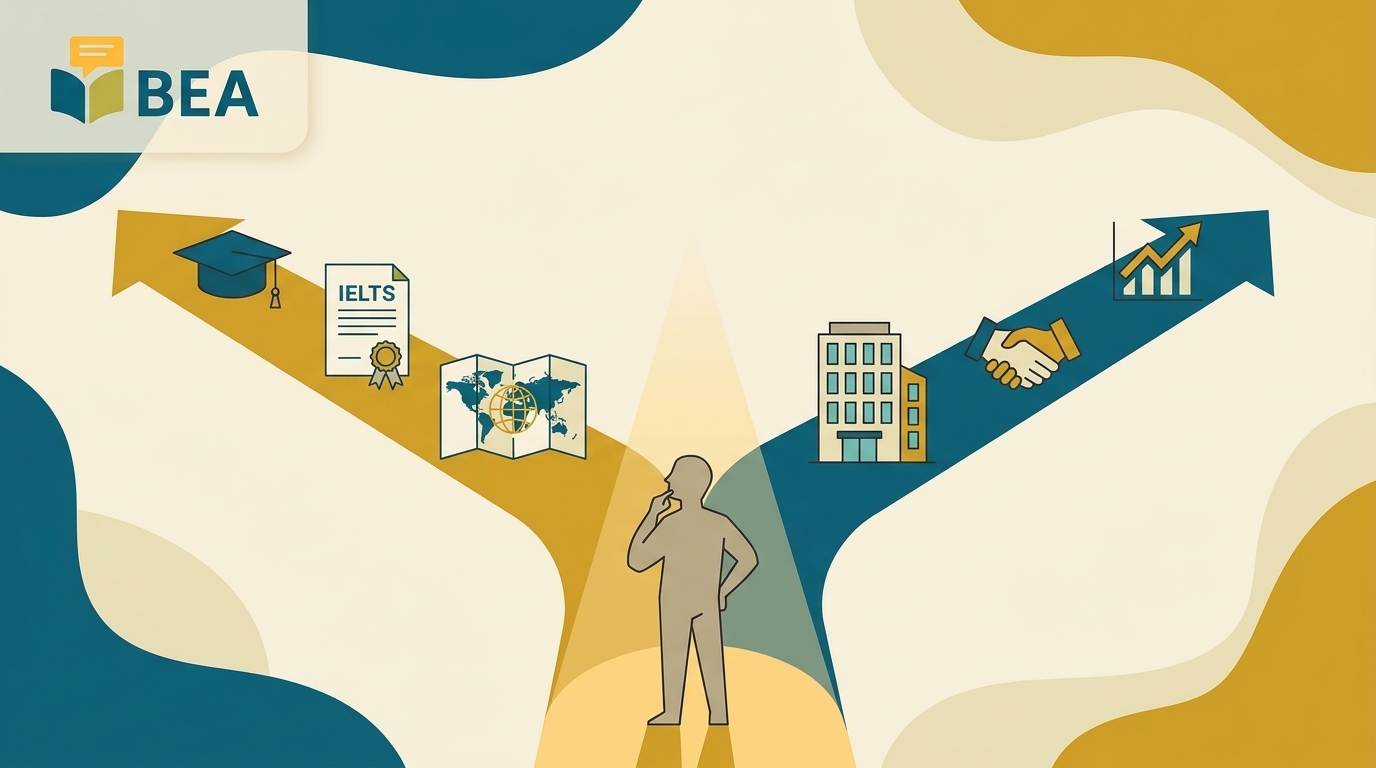
When employers evaluate a candidate’s English proficiency, they rarely need to know whether that person can analyse an academic graph. They need to know whether the candidate can handle a client call, draft a professional email, or follow a briefing under pressure. Understanding the workplace vs academic English test divide is therefore essential — for candidates preparing to be assessed, and for the recruiters and HR teams who commission those assessments.
The distinction matters more in 2026 than ever before. Hybrid workplaces, global supply chains, and multilingual teams mean that employers need precise, job-relevant evidence of English ability. A proxy score designed for university admissions simply does not meet that need. This article explains exactly where the two test types diverge, and why those differences have real consequences.
Why the Workplace vs Academic English Test Purpose Shapes Everything It Measures
Every English test is built around a specific purpose — and that purpose determines every design decision made thereafter. Academic English tests, such as IELTS, exist to predict whether a candidate can succeed in higher education. They measure skills like extended writing, abstract reading comprehension, and academic listening. These are genuinely useful skills — for students. However, they are not the skills a logistics coordinator, customer service manager, or finance analyst uses daily.
By contrast, a workplace English test is designed from the ground up to reflect real professional contexts. It assesses how well a person communicates in the situations their job actually demands. As a result, the vocabulary, task types, and scoring criteria look fundamentally different from anything you would find in an academic assessment.
Notably, a 2023 report by the British Council found that over 60% of employers felt standard academic language qualifications did not fully reflect candidates’ on-the-job communication ability. That gap is precisely what corporate English assessments are designed to close.
5 Key Differences Between Academic and Corporate English Assessments
This is the heart of the workplace vs academic English test debate. Here are five concrete differences that shape employer decisions.
1. Context of Language Use
Academic tests present tasks set in university or study contexts. Corporate tests present tasks drawn from emails, meetings, reports, and client-facing scenarios.
2. Vocabulary Domain
In practice, academic tests reward knowledge of formal, academic register. Workplace tests assess business vocabulary — negotiation language, professional correspondence, and industry-standard phrasing.
3. Task Design
For example, IELTS asks candidates to describe a chart for an academic audience. A corporate test asks candidates to summarise findings for a line manager or draft a follow-up email to a client.
4. Scoring Criteria
Academic tests score heavily on grammatical range and lexical complexity. Workplace tests prioritise clarity, appropriacy, and communicative effectiveness — qualities that actually matter in a professional setting.
5. Turnaround and Format
Academic tests typically involve long examination sessions and weeks-long result timescales. Many corporate assessments are fully online and return results rapidly, which suits the pace of modern recruitment.
What Skills Corporate English Tests Prioritise That IELTS Does Not
The workplace vs academic English test gap becomes clearest when you examine specific skill areas. Corporate assessments typically evaluate listening comprehension in business meetings, the ability to write concise professional correspondence, and spoken fluency in work-relevant exchanges. These scenarios do not appear in academic test formats.
In addition, corporate tests often assess pragmatic competence — the ability to choose the right tone, register, and phrasing for a given professional relationship. A candidate who writes beautifully in an academic register may still sound blunt or inappropriately informal with a client. Academic tests do not capture this.
The BEA English Assessment is specifically designed to reflect these professional communication demands. It gives employers a reliable, standardised measure of how well a candidate handles real workplace language — not how well they perform in an academic examination room.
Candidates benefit too. A workplace-focused assessment lets you demonstrate the English skills you actually use professionally. There is no need to prepare for test types that bear little resemblance to your job.
Getting Started: How to Demonstrate Workplace-Ready English
If you have been asked by an employer or recruitment agency to complete an English assessment in 2026, understanding which type of test you are taking helps you prepare effectively. Focus on professional communication: clear emails, structured spoken responses, and confident comprehension of workplace language. Choosing the right workplace vs academic English test format from the outset makes that preparation far more targeted and effective.
You can learn more about what the assessment involves through the BEA English Assessment website. The platform is straightforward, fully online, and designed to reflect genuine professional communication contexts.
For further context on how English proficiency intersects with UK workplace requirements, the UK Home Office’s English language guidance provides a useful overview of recognised standards.
Conclusion
The workplace vs academic English test distinction is not a minor technicality. It shapes what gets measured, what gets reported to employers, and ultimately what value the assessment delivers to everyone involved. Academic tests serve an important purpose — but that purpose is university admissions, not recruitment. Employers who need job-ready evidence of professional English proficiency need a different tool entirely. Take the BEA English Assessment at beaenglish.co.uk and show employers the communication skills that truly matter in the workplace.