
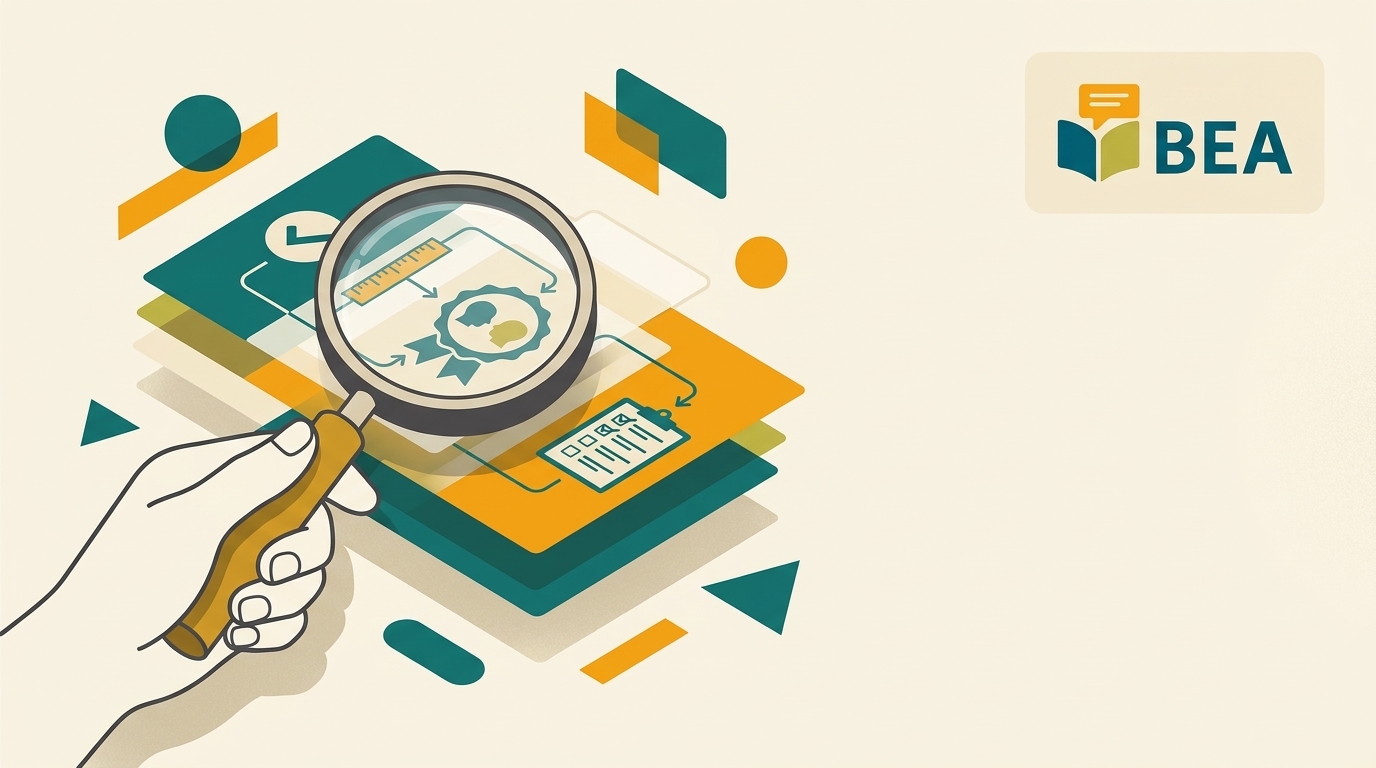
Not every English assessment is built equally. In a market flooded with quick online quizzes and unverified language checks, understanding the rigour behind a test matters enormously—especially when your career or hiring decision depends on the result. BEA test construction validity is the foundation that separates a credible, employer-trusted credential from a meaningless score. This article walks you through exactly how BEA assessment items are created, reviewed, calibrated, and statistically verified before a single result reaches your employer.
Knowing this process builds your confidence as a candidate. It also gives recruiters and HR teams the assurance they need to act on BEA results without hesitation.
Who Authors BEA Assessment Items: The Specialists Behind the Question Bank
Every BEA question—known in assessment terminology as an “item”—begins with a qualified specialist. Item authors are experienced applied linguists and English language assessment professionals. They hold advanced qualifications and understand how language ability distributes across real workplace populations.
In practice, authors do not write items in isolation. Each item targets a specific competency descriptor drawn from BEA’s articulated proficiency framework. For example, a reading comprehension item at B2 level must probe inferential understanding, not simply surface recall. This precision prevents vague or misleading questions from entering the bank.
Furthermore, authors document the intended difficulty level, the target skill, and the anticipated response pattern for every single item. That documentation travels with each question through every subsequent stage. As a result, no item ever loses its evidence trail—a critical feature of any rigorous assessment system.
BEA Test Construction Validity in Practice: The Multi-Stage Item Review and Calibration Process
Once authors submit items, the review process begins. A panel of independent reviewers—distinct from the authors—evaluates each item for linguistic accuracy, cultural fairness, and alignment with the target competency. Items that introduce ambiguity or cultural bias are returned for revision or rejected entirely.
However, editorial review alone is insufficient. BEA then enters a pretesting phase. New items appear alongside established, calibrated items in live test administrations. Candidate responses are collected without those pretest items contributing to official scores. This approach is standard practice in high-stakes assessment design, as recommended by the Standards for Educational and Psychological Testing published jointly by the American Educational Research Association, the American Psychological Association, and the National Council on Measurement in Education.
During pretesting, statisticians analyse each item’s difficulty index and discrimination index. The difficulty index measures how many candidates answer correctly. The discrimination index measures whether high-ability candidates outperform lower-ability candidates on that item. Items that fail either threshold are revised or removed. Consequently, only items with proven psychometric performance ever enter the live, scored item bank.
How BEA Scores Are Statistically Validated Before Any Result Is Released
BEA test construction validity extends beyond individual items to the overall scoring model. Every completed test administration passes through automated statistical checks before a score report is generated. These checks flag anomalous response patterns—such as implausibly fast completion times or inconsistent performance across skill areas—that might indicate a compromised sitting.
In addition, BEA applies equating procedures to ensure that scores remain comparable across different test versions and sitting dates. Equating adjusts for minor variation in item difficulty between forms. This means a Band 4 achieved in March 2026 represents identical ability to a Band 4 achieved in September 2026. This comparability is essential for employers who assess candidates across multiple recruitment cycles throughout the year.
Notably, score reports include a confidence interval—a statistical range indicating the precision of the result. This transparency helps employers interpret scores responsibly rather than treating a single number as an absolute boundary. You can explore the full scoring framework at BEA English Assessment, where detailed guidance supports both candidates and commissioning organisations.
What Separates a Genuine Credentialled Assessment From an Unverified Online Imitation
By contrast, most free or low-cost online language checks share none of the features described above. They lack documented item authorship, independent review panels, pretesting data, or equating procedures. A score from such a tool carries no evidentiary weight in a professional context because no validation chain exists.
For recruiters, commissioning an unverified test creates real risk. Hiring a candidate whose English level has been misrepresented—however unintentionally—can damage team productivity and client relationships. For candidates, an unverified result offers no protection if their ability is later questioned on the job.
Therefore, BEA test construction validity is not an abstract technical virtue. It is a practical guarantee that the score you receive reflects your genuine ability—and that employers can rely on it when making consequential decisions.
Getting Started: How to Register and Take Your BEA Assessment
Taking the next step is straightforward. Whether your employer has directed you to BEA or you are proactively demonstrating your English proficiency to a recruiter, the process begins online. Visit BEA English Assessment to create your candidate account, review the test format, and select an available sitting. The platform guides you clearly through each stage. Verified score reports are issued promptly after your results clear statistical validation.
Conclusion: Rigour You Can Trust
BEA test construction validity underpins every score report issued under the BEA brand. Specialist authors, independent reviewers, live pretesting, and statistical equating work together to ensure your result is accurate, fair, and comparable. Ready to take the real, rigorously validated assessment? Visit BEA English Assessment at beaenglish.co.uk to register and receive a verified score report trusted by employers across the UK and beyond.