
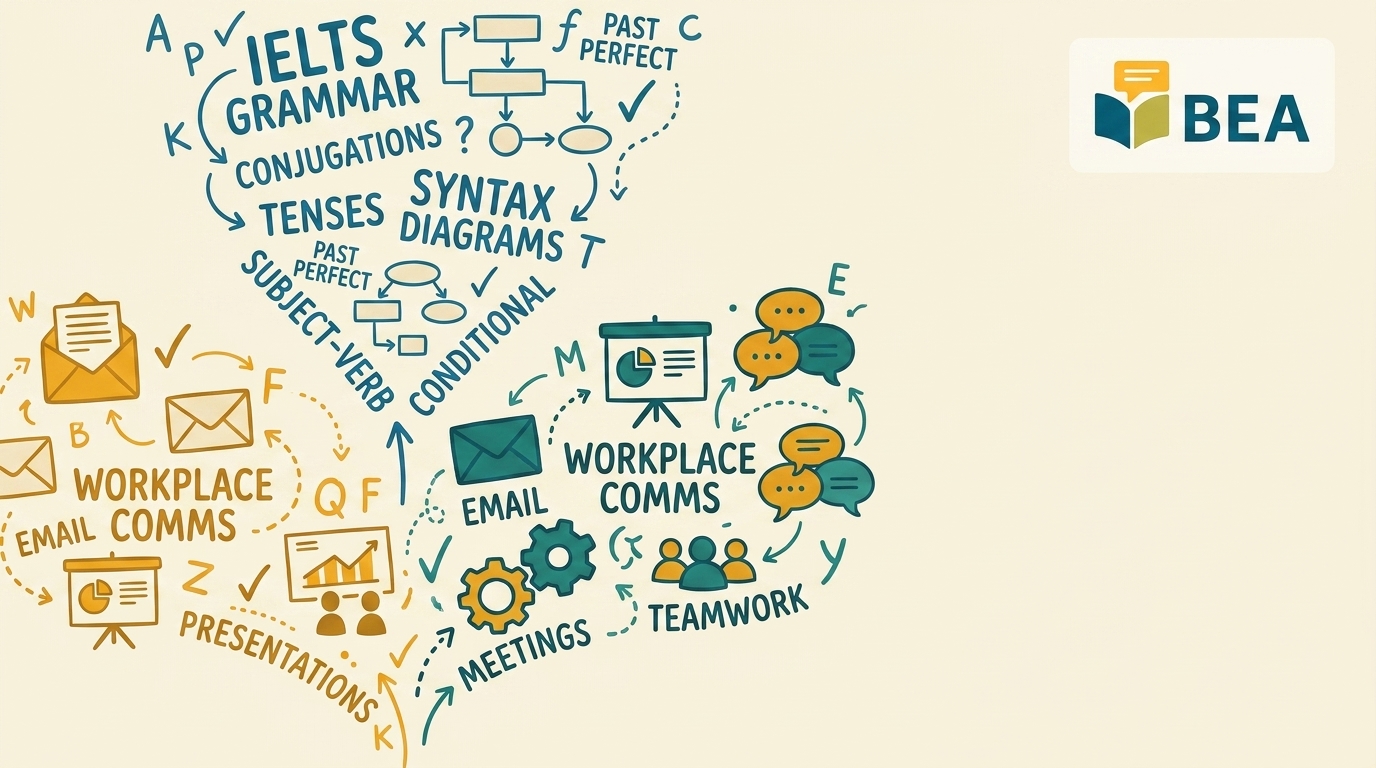
When employers request an English assessment, they rarely care whether a candidate can identify a subjunctive clause. They want to know: can this person write a clear email, follow complex instructions, and communicate under pressure? That distinction sits at the heart of the corporate vs academic English test debate — and it matters enormously for both candidates and the recruiters who commission assessments. Understanding what each type of test actually measures helps everyone make smarter hiring decisions.
Traditional academic English tests were designed for university admissions. They serve that purpose well. However, they were never built to reflect the demands of a modern workplace. In 2026, that gap is wider than ever.
Corporate vs Academic English Test: Where Does That Leave Workplace Readiness?
Academic English tests focus on four core skills: reading, writing, listening, and speaking. However, they measure these skills in highly controlled, exam-room conditions. Candidates read dense academic passages, write analytical essays, and discuss abstract topics with trained examiners.
For example, a candidate might write a 250-word essay comparing two bar charts. That task requires accuracy. It does not require the candidate to adapt tone, respond to a colleague’s ambiguous request, or summarise a meeting for a senior manager.
In fact, the British Council’s research on English in the workplace has highlighted that workplace English demands centre on interaction, real-time comprehension, and task-specific writing — competencies that structured exam formats rarely simulate. Candidates who score highly on academic tests sometimes struggle when asked to draft a concise professional report or navigate a difficult client call.
Furthermore, academic tests award marks for grammatical complexity. Workplace communication often rewards brevity and clarity instead. Notably, a candidate who uses simpler, precise language frequently outperforms one who constructs elaborate sentences in a professional setting.
That said, that gap is not a flaw in academic testing. Those tools achieve what they promise. The problem arises when recruiters use the wrong tool for the job — assessing corporate readiness through an academic lens.
Four Competencies Corporate English Assessments Prioritise That Academic Tests Largely Ignore
The corporate vs academic English test distinction becomes clearest when you compare specific competencies. Corporate English assessments — properly designed ones — target skills that directly predict job performance.
1. Professional writing register. Candidates produce emails, summaries, and short reports. Assessors evaluate whether the tone, structure, and vocabulary suit a business audience. This differs sharply from essay-writing under exam conditions.
2. Workplace listening comprehension. Rather than listening to a lecture excerpt, candidates interpret realistic scenarios: a briefing from a manager, a recorded client call, or a team discussion. Contextual inference matters here — not just accurate transcription.
3. Functional spoken fluency. Corporate assessments evaluate whether a candidate can explain a process, handle a complaint, or present a recommendation — not simply whether they avoid grammatical errors.
4. Task-specific reading. Candidates read memos, policy documents, and professional correspondence. By contrast, academic tests ask candidates to engage with journal abstracts and scholarly arguments.
Consequently, a well-designed corporate assessment produces results that line managers can actually interpret. A CEFR level (the Common European Framework of Reference for Languages) paired with a workplace-specific breakdown tells a recruiter far more than a band score from an exam designed for student visa applications.
How BEA English Assessment Aligns With Professional Communication Demands Over Exam-Room Skills
BEA English Assessment was built specifically for professional contexts. Every task within the assessment reflects a real workplace scenario. Candidates do not face abstract academic prompts — they engage with communication challenges drawn from professional environments.
In practice, this means the results speak directly to employers. A hiring manager receives a CEFR-aligned score alongside a breakdown of how the candidate performs across professional writing, reading comprehension, and spoken communication. That clarity accelerates hiring decisions significantly.
Moreover, the assessment removes the need for lengthy preparation courses. Candidates take the test based on their existing professional English ability — not on their familiarity with a particular exam format. This makes the corporate vs academic English test comparison especially relevant for candidates who have years of professional experience but no recent academic qualification.
In addition, understanding where a corporate vs academic English test differs in design helps recruiters brief candidates more effectively before screening begins — reducing drop-off and improving the quality of applications received.
Furthermore, BEA results carry credibility because they align with the internationally recognised CEFR standard. Recruiters and HR teams across Europe and beyond already use CEFR levels to define role requirements. A verified BEA result slots directly into that framework.
Getting Started: How Candidates and Recruiters Use BEA in 2026
The process is straightforward. Candidates visit BEA English Assessment at beaenglish.co.uk, complete the assessment online, and receive a verified result. Meanwhile, recruiters and employers can also commission assessments directly, integrating BEA into existing hiring workflows without disruption.
Therefore, whether you are a candidate preparing for a new role or a recruiter standardising your screening process, the next step is simple.
Conclusion: Choose the Assessment That Matches the Role
The corporate vs academic English test question has a clear answer for professional hiring contexts. Academic tests measure what they were designed to measure — student readiness. By contrast, corporate assessments measure what employers actually need. Ready to demonstrate the English skills employers value? Take the BEA English Assessment at https://beaenglish.co.uk and receive a verified, CEFR-aligned result built for the modern workplace.