
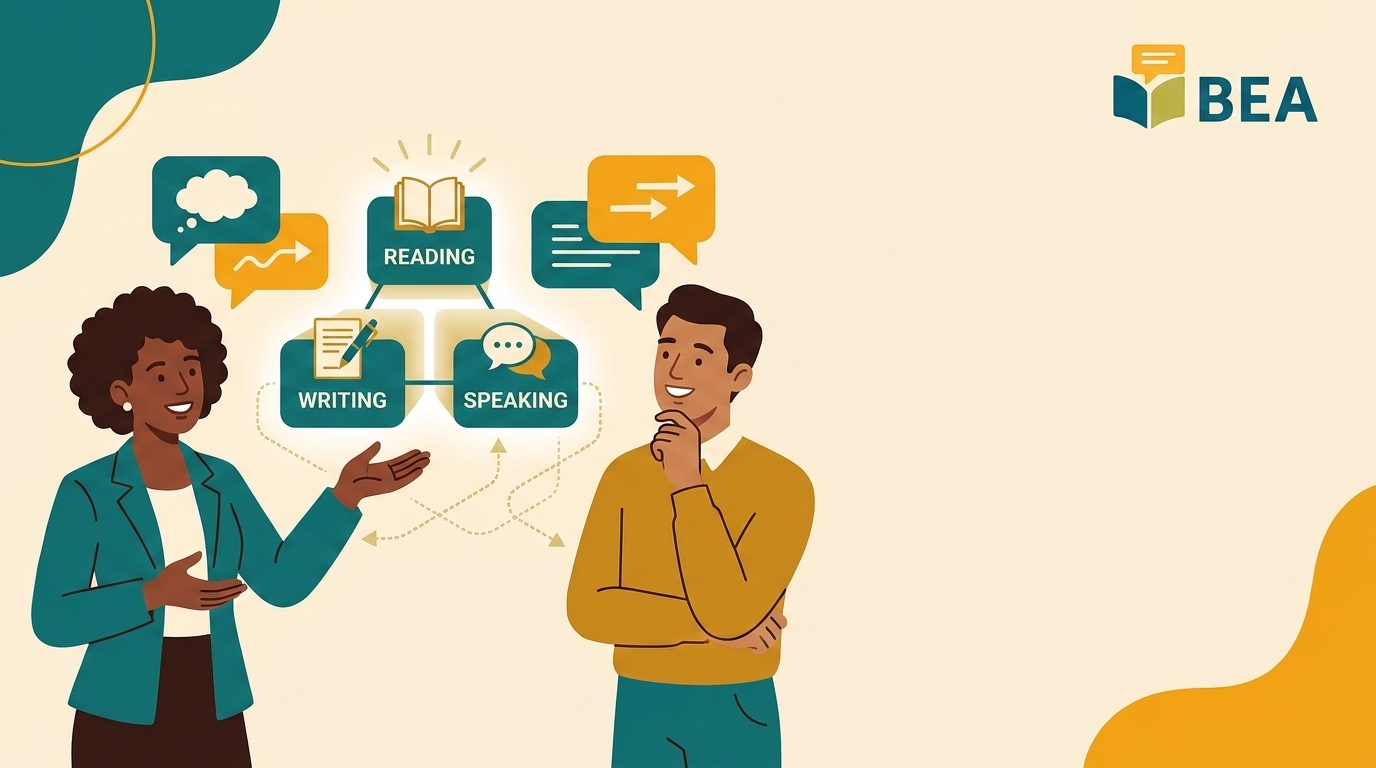
Understanding exactly what an English assessment measures can feel daunting — especially when your job offer depends on the result. Many candidates arrive at test day unsure which skills will be evaluated or how the structure works. Having the BEA assessment sections explained clearly before you begin makes a significant difference to your confidence and performance. This article breaks down each part of the assessment, explains what it measures, and tells you what to expect from start to finish.
Whether you are a candidate directed here by an employer, or a recruiter commissioning assessments for your team, this guide gives you the full picture. Read on to understand exactly why each section exists and how the results are used.
What Is the BEA English Assessment and Who Is It Designed For?
The BEA English Assessment is a professionally developed online test that measures English language proficiency in workplace contexts. It is designed primarily for two audiences: candidates who need to demonstrate their English ability as part of a job application or visa process, and employers or recruitment agencies who require an objective, standardised measure of language competence.
In practice, organisations use the BEA to verify that candidates can communicate effectively in professional environments. This matters more than ever in 2026, as research from the British Council confirms that 80% of employers across global growth markets now require staff to demonstrate measurable English proficiency before being hired. The BEA provides that evidence in a format that is easy to administer, cost-effective, and recognised by recruiters across multiple sectors.
Furthermore, the assessment is entirely online, making it accessible to candidates regardless of location. You complete it at your own pace within a secure digital environment, removing the logistical barriers of traditional pen-and-paper tests.
BEA Assessment Sections Explained: What Each Part of the BEA Tests
The BEA assessment sections explained in their simplest form cover four core areas: reading, writing, listening, and language use. Each section is designed to reflect real-world communication demands rather than abstract grammar exercises.
Reading presents you with professional texts — such as workplace emails, reports, and notices — and asks you to demonstrate comprehension and interpretation. Writing tasks require you to produce structured responses, such as formal emails or short reports, based on a given scenario. Listening uses audio material that mirrors workplace conversations, briefings, or instructions. Finally, language use (sometimes called grammar and vocabulary) tests your accuracy and range in context, not in isolation.
For example, a candidate applying for a customer-facing role might encounter a listening task based on a telephone enquiry, directly simulating the type of communication they would handle daily. This contextual approach ensures results reflect genuine workplace readiness rather than test-taking ability alone.
In addition, each section is weighted to reflect its importance in professional communication. Writing and reading carry significant weight because written communication underpins most modern business activity.
What Skills Does Each Section Actually Measure?
Beyond the surface task, each section of the BEA targets specific underlying competencies. Understanding these helps both candidates and employers interpret results meaningfully.
Reading measures your ability to locate information, infer meaning, and understand tone — critical skills for processing workplace documents accurately. Writing assesses clarity, coherence, register (the level of formality), and grammatical accuracy. A strong writing score signals that a candidate can draft professional correspondence independently.
Listening evaluates comprehension speed, the ability to follow complex instructions, and sensitivity to implicit meaning. By contrast, language use examines the accuracy of grammar and the breadth of vocabulary a candidate can deploy in context. A wide vocabulary range often correlates with the ability to adapt communication style across different professional scenarios.
Notably, the BEA does not test spoken English in its current format. However, the listening and writing sections together provide a strong proxy for overall communicative competence. Employers reviewing results can therefore draw reliable conclusions about a candidate’s day-to-day language ability. You can explore the full scoring methodology by visiting BEA English Assessment at beaenglish.co.uk.
How Long Is the Assessment and What Should You Expect on Test Day?
The BEA assessment takes approximately 60 to 90 minutes to complete in full. You work through each section sequentially in a single session, so plan uninterrupted time before you begin.
On test day, you will need a stable internet connection, a quiet environment, and access to audio for the listening section. The platform is browser-based, so no specialist software is required. Instructions appear clearly before each section, giving you time to orient yourself before the tasks begin.
In fact, most candidates report that the format feels intuitive after the first section. The progression from reading through to language use follows a logical sequence that mirrors natural communication flow. Results are typically available promptly, allowing employers and recruiters to act quickly on hiring decisions.
According to the British Council’s English at Work report, organisations that use standardised English assessments reduce miscommunication-related errors by up to 30% within the first year of implementation. The BEA directly supports this outcome by producing clear, comparable scores rather than subjective evaluations. For further detail on global English proficiency benchmarks, the British Council’s research on English in the workplace provides authoritative context.
Frequently Asked Questions About BEA Assessment Sections
Does the BEA assessment follow CEFR levels?
Yes. Results align with the Common European Framework of Reference for Languages (CEFR) — the internationally recognised standard that describes language ability from A1 (beginner) to C2 (proficient). This alignment means employers and recruiters can benchmark candidates against a globally understood scale.
Can I retake the assessment if I am unhappy with my score?
Yes, candidates may retake the assessment. Each attempt requires a separate registration and payment of the £99 fee. Retaking allows you to demonstrate improvement after additional preparation.
How do employers receive results?
Results are delivered digitally and can be shared directly with the commissioning employer or recruitment agency. The report format is designed to be easy for non-specialists to interpret, presenting both section scores and an overall level.
Is the BEA assessment sections explained differently for different job roles?
The structure remains consistent across all candidates. However, employers may weight particular sections differently depending on the communication demands of the role. A writing-heavy role, for instance, may place greater emphasis on the writing section score during shortlisting.
Is the assessment supervised?
The BEA uses built-in integrity measures within its online platform. You are not required to attend a physical test centre, which makes the process far more convenient — particularly for candidates in remote locations or those with busy schedules.
Getting Started: How to Register and Take the BEA
Taking the next step is straightforward. You register directly through the BEA platform, pay the one-time £99 fee, and gain immediate access to the assessment. There is no lengthy enrolment process or waiting period.
With this in mind, preparation is always worthwhile. Reviewing the section breakdown in this article gives you a clear mental map of what lies ahead. Spend time practising professional reading and writing tasks, and ensure your listening environment is free from distraction before you begin.
Employers and recruiters who wish to commission assessments for candidates can also arrange this directly through the platform. The process is designed to be simple for both parties, with results delivered efficiently to support timely hiring decisions.
Conclusion: Why Understanding the BEA Structure Sets You Up for Success
Having the BEA assessment sections explained in full removes uncertainty and replaces it with confidence. Each section has a clear purpose, measures specific professional skills, and contributes to a result that employers and recruiters can trust. Understanding this structure helps you perform at your genuine level — rather than being caught off guard by unfamiliar task types.
Ready to take the BEA English Assessment? Visit BEA English Assessment at beaenglish.co.uk to register, pay the £99 fee directly, and complete your assessment today.