
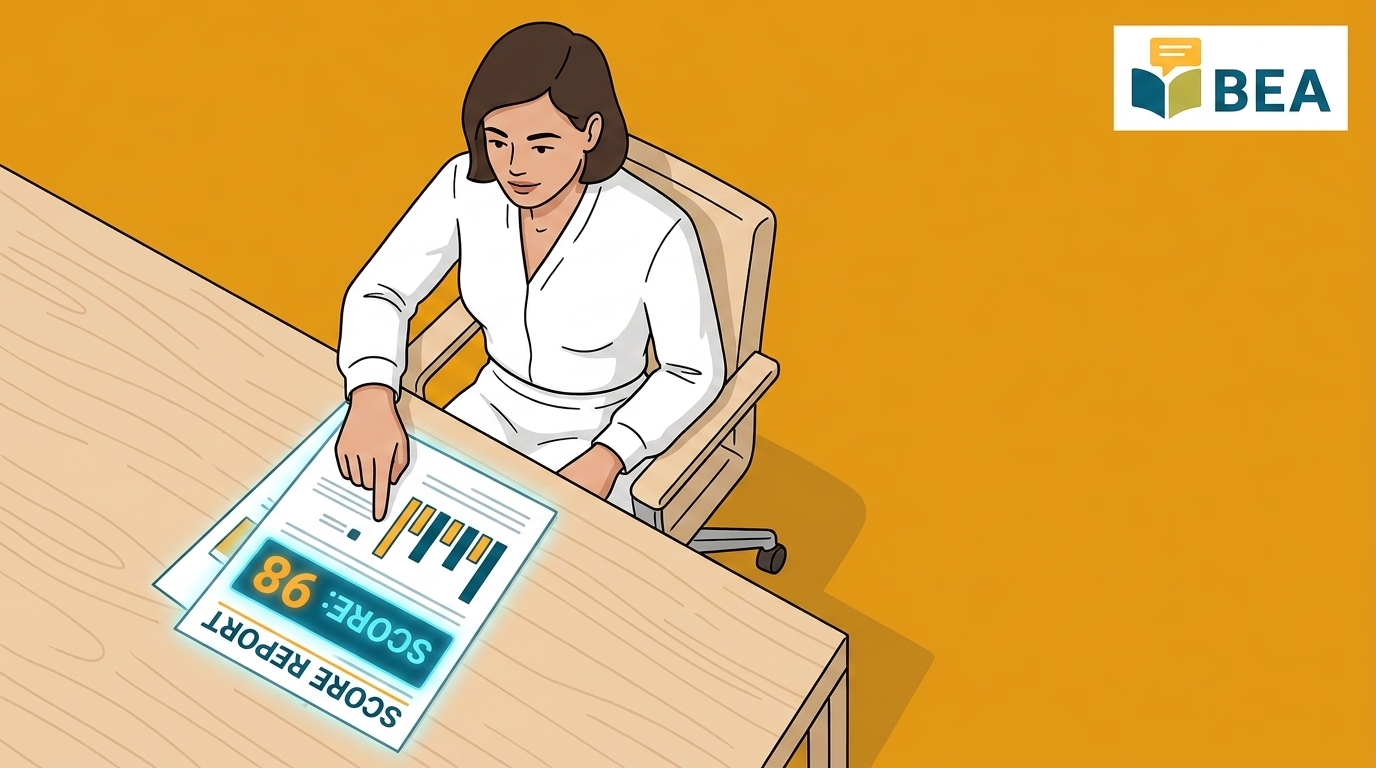
You have just completed the BEA Assessment and your results have arrived. Now you are staring at a document full of bands, descriptors, and skill labels — and wondering what any of it actually means. Having your BEA score report explained clearly can make the difference between walking into an employer conversation with confidence and walking in unsure of your own strengths.
The BEA (Business English Assessment) measures workplace English across clearly defined skill areas. Each section produces a score that maps directly onto the Common European Framework of Reference for Languages, or CEFR. This is the internationally recognised scale running from A1 (beginner) to C2 (mastery). Understanding that framework is the first step to reading your results with clarity.
This article breaks down every element of your score report, section by section, so you know exactly what employers and recruiters see when they review your results.
What Does Your BEA Score Report Actually Contain?
Your score report is not a single number. It presents a profile of your English ability across multiple skill areas, each scored independently. Most candidates find this more useful than a single overall mark. It shows precisely where your English is strong and where development may help.
In practice, the report includes your performance in reading, listening, writing, and language use. Each skill receives its own band score and a short descriptor. Furthermore, the report states your overall CEFR level, giving employers an instant benchmark they can compare globally.
For example, a candidate applying for a bilingual customer service role might score B2 in reading but B1 in writing. That distinction matters enormously to a hiring manager deciding on role suitability. The granular breakdown is therefore far more actionable than a pass/fail outcome.
According to the British Council’s CEFR overview, CEFR is used by over 50 countries as a standard reference for language certification and recruitment decisions. Consequently, your score is internationally portable and credible.
BEA Score Report Explained: Skills Measured and CEFR Alignment
Reading Comprehension
This section tests your ability to understand written workplace texts — emails, reports, notices, and instructions. Scores reflect not just vocabulary range but your ability to infer meaning and identify key information quickly.
Listening Comprehension
Here you respond to spoken workplace scenarios: briefings, phone conversations, and meetings. The assessment measures accuracy, not just broad understanding. Higher bands indicate you can follow complex, fast-paced speech without repetition.
Writing Production
The writing section evaluates grammar accuracy, vocabulary range, and the ability to structure a professional message. Writing is assessed against clear marking criteria aligned to CEFR descriptors.
Language Use
This section covers grammar and vocabulary in context. It does not test rules in isolation. Instead, it tests whether you apply language correctly in realistic workplace situations.
By contrast, many general English tests focus on academic language. The BEA focuses entirely on professional and business contexts. In addition, its CEFR alignment makes it especially relevant for corporate recruitment. You can explore the full assessment structure on the BEA English Assessment website.
How to Read Your Band Descriptors and What They Signal to Employers
Each band in the BEA score report explained document carries a descriptor. These are short, plain-language statements describing what a candidate can do at that level. They are written for both candidates and employers, so the language is accessible.
For instance, a B2 writing descriptor might read: “Can write clear, detailed texts on professional topics and express a viewpoint with reasonable accuracy.” An employer reading this immediately understands what to expect from you on the job.
That said, band descriptors are not binary judgments. A solid B1 score signals genuine workplace competence for many roles. A C1 score may distinguish you for senior or client-facing positions requiring high-stakes written communication.
Notably, recruiters increasingly request standardised assessments precisely because they reduce subjective bias in shortlisting. Your BEA band gives them an objective, consistent data point alongside your CV.
More importantly, having the BEA score report explained in plain terms helps you speak confidently about your results in interviews. You are not just handing over a document — you are demonstrating self-awareness about your professional English profile.
Frequently Asked Questions About BEA Results and Next Steps
How long does my BEA score remain valid? Results are typically valid for two years from the test date. Always confirm validity requirements with the employer or agency commissioning the assessment.
Can I retake the BEA if I am unhappy with my score? Yes. Retakes are available. Reviewing your section-by-section breakdown first helps you focus preparation on the skills with the most room for improvement.
Will employers receive my results automatically? Your score report belongs to you. You share it directly with employers or recruiters as part of your application.
What CEFR level do most professional roles require? Most professional office roles in the UK require at least B2. Roles involving client communication or report writing often specify C1 or above.
Does the BEA assess spoken English? The current assessment focuses on reading, listening, writing, and language use. Meanwhile, check the latest format at BEA English Assessment for any updates to the 2026 version.
Understanding Your Results Is the First Step Forward
Therefore, having the BEA score report explained properly reveals far more than a pass or fail. It gives you a skill-by-skill portrait of your professional English, mapped to an internationally trusted framework. Any employer, anywhere, can interpret it with confidence.
Ready to understand your results in full? Take the BEA Assessment at BEA English Assessment and receive a detailed score report you can share with any employer — whether you are beginning a job search or advancing your career.