
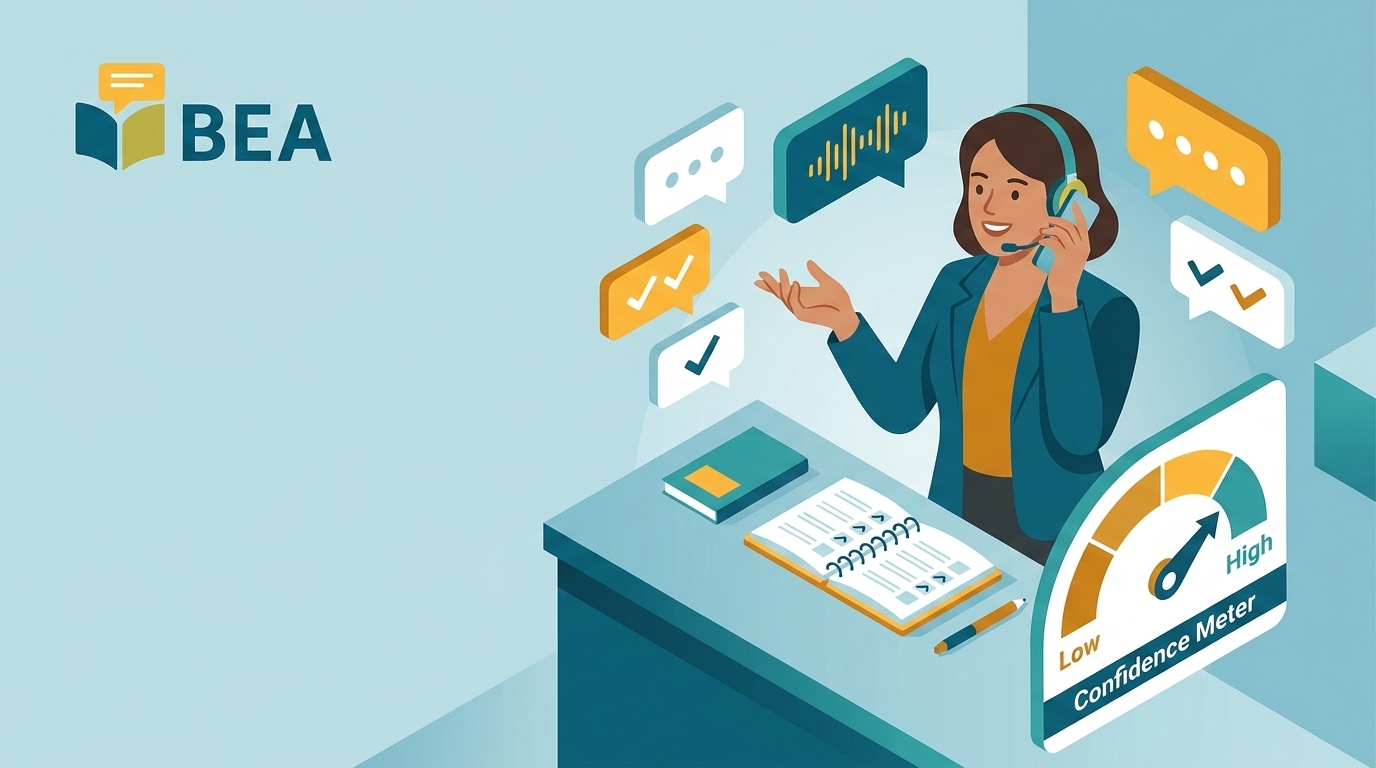
Handling workplace English customer calls is one of the most demanding communication challenges professionals face today. Unlike emails, calls offer no time to pause, edit, or rephrase. You must listen, process, and respond — all in real time, often under pressure.
For non-native English speakers working in customer-facing roles, this pressure is even greater. A misunderstood question or an unclear reply can damage client relationships and reflect poorly on your employer. In 2026, with remote and international teams more common than ever, spoken English on calls has become a critical professional skill.
This four-week drill plan gives you practical, structured steps to improve — from answering basic queries to managing difficult escalations with confidence.
Why Workplace English Customer Calls Differ From Written Communication — and Why It Matters
Written English allows you to plan, review, and rewrite. Spoken English on customer calls does none of that. Instead, it demands active listening, spontaneous grammar, and tone management — all simultaneously.
For example, a customer who says “I’ve been waiting on this for ages” is expressing frustration, not simply requesting information. Recognising that emotional signal — and responding with empathy before offering a solution — is a skill that no spell-checker can provide.
In practice, the gap between written and spoken fluency is often larger than candidates expect. According to the British Council’s English at Work report, employers consistently rate speaking and listening as the most important English skills in the workplace. However, they are the least formally trained.
Furthermore, workplace English customer calls carry specific vocabulary. Terms like “escalation,” “call resolution,” and “active listening” all need to become natural to you. Escalation means passing a complaint to a senior team member. Call resolution means fully solving a customer’s issue in one contact.
Therefore, treating call English as a distinct skill — separate from general English learning — is the first step toward genuine improvement.
Week-by-Week Drill Plan: From Basic Call Scripts to Complex Escalations
This four-week plan builds skills progressively. Each week targets a specific layer of call communication.
Week 1 — Core Phrases and Call Structure. Record yourself answering a standard greeting, taking a message, and closing a call politely. Focus on clarity and pace. Aim for sentences under 15 words. Review the recording and note where you hesitate or lose fluency.
Week 2 — Active Listening and Clarification. Practise phrases such as “Just to confirm, you’re saying…” and “Could you repeat that last part, please?” These signal attentiveness. Drill these with a partner or language exchange app daily for 15 minutes.
Week 3 — Handling Complaints and Difficult Callers. In practice, most professionals struggle most here. Script three complaint scenarios and respond using the “acknowledge, apologise, act” structure. For example: “I completely understand your frustration. I’m sorry for the inconvenience. Let me resolve this for you right now.”
Week 4 — Escalations and Professional Vocabulary. Simulate a call where you cannot resolve the issue yourself. Practise handing over clearly: “I’d like to connect you with our senior team, who can address this more effectively.” Confidence in escalation language prevents calls from breaking down.
By the end of week four, you will have drilled over 20 hours of spoken practice across realistic workplace English customer calls scenarios.
Common Mistakes Professionals Make on English-Language Calls (and How to Fix Them)
However skilled you are in writing, spoken calls expose different gaps. Here are the most frequent errors and their fixes.
Talking too fast under pressure. Anxiety speeds up speech, reducing clarity. Fix: practise with a metronome app set to a calm rhythm, and pause deliberately after each sentence.
Using filler words excessively. “Um,” “like,” and “you know” undermine professional credibility. Fix: replace fillers with a deliberate pause. Silence sounds more confident than hesitation noise.
Failing to confirm understanding. Many professionals assume they have understood correctly and move on. Consequently, errors multiply. Fix: always summarise back to the caller before taking any action.
Overly formal or robotic phrasing. Reading directly from a script sounds insincere. Fix: internalise the structure but vary the exact words each time. Natural delivery builds caller trust.
In addition, avoiding idiomatic English on calls is a mistake. Callers use idioms constantly — “touch base,” “loop you in,” “take it offline.” Notably, mastering these expressions is essential for workplace English customer calls in any customer-facing role. Familiarise yourself with the 20 most common business call idioms used in your industry in 2026.
Getting Started: Turn Practice Into Proof
Once you have worked through the four-week drill, you need a way to show your employer or recruiter that your spoken English skills meet professional standards. Practice builds confidence, but a verified score builds credibility.
BEA English Assessment offers a rigorous, employer-recognised English proficiency test designed specifically for the workplace. The assessment evaluates real-world language skills that matter in professional settings. More importantly, it covers the spoken comprehension and vocabulary needed on workplace English customer calls.
Meanwhile, the smartest next step is to schedule your assessment once your four-week drill is complete. Arrive prepared, perform at your peak, and share a score that speaks for itself.
Frequently Asked Questions: Improving Spoken English for Work
How long does it take to improve workplace English for customer calls? Most professionals notice measurable improvement within four to six weeks of consistent, focused practice. Daily 15-minute drills outperform occasional hour-long sessions. Consistency matters more than volume.
Can I improve without a conversation partner? Yes. Record-and-review practice, shadowing native speaker audio, and using language exchange apps all build fluency effectively. However, real-time conversation with a partner accelerates progress significantly.
What vocabulary should I prioritise for customer calls? Focus on three clusters: opening and closing phrases, clarification and confirmation language, and complaint-handling vocabulary. These cover the vast majority of call scenarios you will encounter in 2026.
Does a formal English assessment help with career progression? Absolutely. Employers and recruiters increasingly request verified English scores alongside CVs. As a result, a recognised score from BEA English Assessment removes any doubt about your communication level and strengthens your professional profile.
Should I focus on accent reduction? No. Clarity and confidence matter far more than accent. Callers respond to pace, structure, and empathy — not to a specific regional sound. By contrast, focusing on those elements delivers faster, more practical results.
Conclusion: From Drill to Verified Confidence
Four consistent weeks of targeted practice can transform your performance on workplace English customer calls. By building structure, vocabulary, and active listening skills progressively, you move from reactive to confident — and from hesitant to credible. Once your skills are sharp, take the next step: complete the BEA English Assessment at https://beaenglish.co.uk and share a verified score that proves your professional English ability to every employer or recruiter who needs to know.