
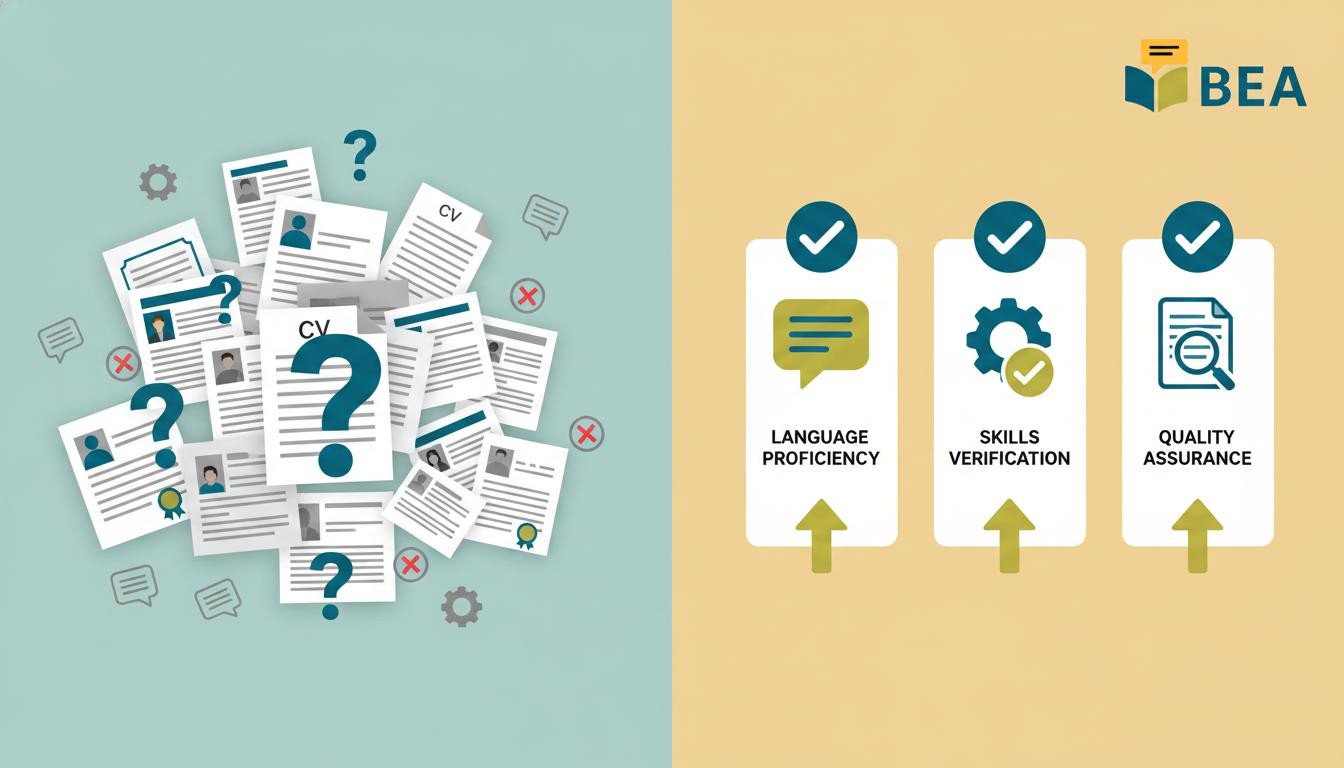
For decades, the curriculum vitae has served as the primary gateway into employment. Hiring managers have scanned bullet points, scrutinised job titles, and made rapid judgements about a candidate’s communication ability based on the quality of their written application. In theory, a well-constructed CV should signal strong English proficiency. In practice, the reality is considerably more complicated — and the consequences of getting it wrong are measurable.
The Hidden Cost of Relying on CVs to Judge English Proficiency
A CV is, by its nature, a curated document. Candidates may receive assistance from professional CV writers, AI tools, friends, or family members — all of whom may have stronger English skills than the applicant themselves. The result is a polished surface that tells you very little about how that individual will perform in a client-facing conversation, a technical briefing, or a high-pressure email exchange.
This matters acutely for roles where English proficiency is not merely desirable but operationally essential. Customer service positions, compliance-sensitive roles, healthcare administration, and client relationship management are just a few examples where a mismatch between perceived and actual language ability can lead to costly errors, reputational damage, and elevated staff turnover.
Recruiters working at volume face an additional challenge. When processing hundreds of applications for a single vacancy, there is simply not enough time to conduct a meaningful language evaluation at the screening stage. Interviewers may attempt an informal assessment during a telephone call, but this approach lacks consistency, documentation, and any form of benchmarking. Two candidates may receive entirely different questions, be assessed by different interviewers, and be measured against invisible and subjective standards.
The financial cost of a mis-hire is well documented. Research consistently places it at between one and three times the annual salary of the role in question, accounting for lost productivity, re-recruitment, and onboarding. When English proficiency is a core job requirement, failing to assess it rigorously at the outset is not merely an inconvenience — it is a significant commercial risk.
How Standardised English Assessments Create a Fairer, More Defensible Hiring Process
A standardised English assessment for employers addresses each of these vulnerabilities directly. By applying the same evaluation criteria to every candidate, in a controlled and consistent format, organisations gain data that is both comparable and defensible.
Consistency is the foundational benefit. When every applicant completes the same tasks under the same conditions, the resulting scores reflect genuine differences in ability rather than differences in how they were assessed. This is particularly valuable for organisations operating across multiple sites, or those working with external recruitment agencies, where hiring decisions may be made by different individuals in different locations.
Fairness is an equally important dimension. A rigorous standardised English assessment for employers evaluates what a candidate can actually do with the language — reading, writing, comprehension, and professional communication — rather than what their CV suggests they can do. This approach tends to surface high-potential candidates who may present less confidently on paper, while also identifying candidates whose written applications significantly overstate their practical ability.
From a legal and compliance standpoint, standardised assessments also provide something informal screening cannot: an auditable record. If a hiring decision is ever challenged, organisations need to demonstrate that their process was objective, role-relevant, and applied consistently. Assessment scores, tied to clearly defined benchmarks, provide exactly that documentation.
For recruitment agencies commissioning assessments on behalf of client employers, this objectivity has an additional commercial value. Providing verified language data alongside a candidate shortlist positions the agency as a trusted, quality-conscious partner — not simply a volume supplier.
What to Look for When Selecting an English Assessment for Your Organisation
Not all English tests are created equal, and selecting the right standardised English assessment for employers requires careful evaluation of several key criteria.
Validity and alignment to workplace contexts. A strong assessment evaluates language as it is actually used at work — not through abstract grammar exercises disconnected from professional scenarios. Look for assessments built around realistic tasks such as comprehension of business documents, written responses to workplace situations, and evaluation of professional register.
Scalability and ease of administration. Whether you are assessing ten candidates or ten thousand, the platform should support your volume without creating administrative burden. Online delivery, automated scoring, and rapid results turnaround are now standard expectations.
Clear, interpretable reporting. Assessment data should be immediately useful to hiring managers who are not language specialists. Results should map to defined proficiency levels and, ideally, to the specific requirements of your roles.
Reliability over time. A credible standardised English assessment for employers maintains consistent standards across different versions and delivery windows, ensuring that a score from one recruitment cycle is genuinely comparable to a score from another.
Support and expertise. The organisation behind the assessment should be able to advise on appropriate benchmarks for different role types, support integration into your existing recruitment workflow, and provide guidance on interpreting results in context.
The shift towards evidence-based hiring is not a trend — it is a response to the real and quantifiable costs of subjective, inconsistent evaluation. As English proficiency becomes an increasingly critical differentiator across industries and geographies, the organisations that invest in robust assessment processes will be better placed to hire accurately, onboard efficiently, and retain the talent they work hard to attract.
See how BEA English Assessment gives your hiring team objective, job-ready language data. Visit beaenglish.co.uk to request a demo or learn about volume pricing.